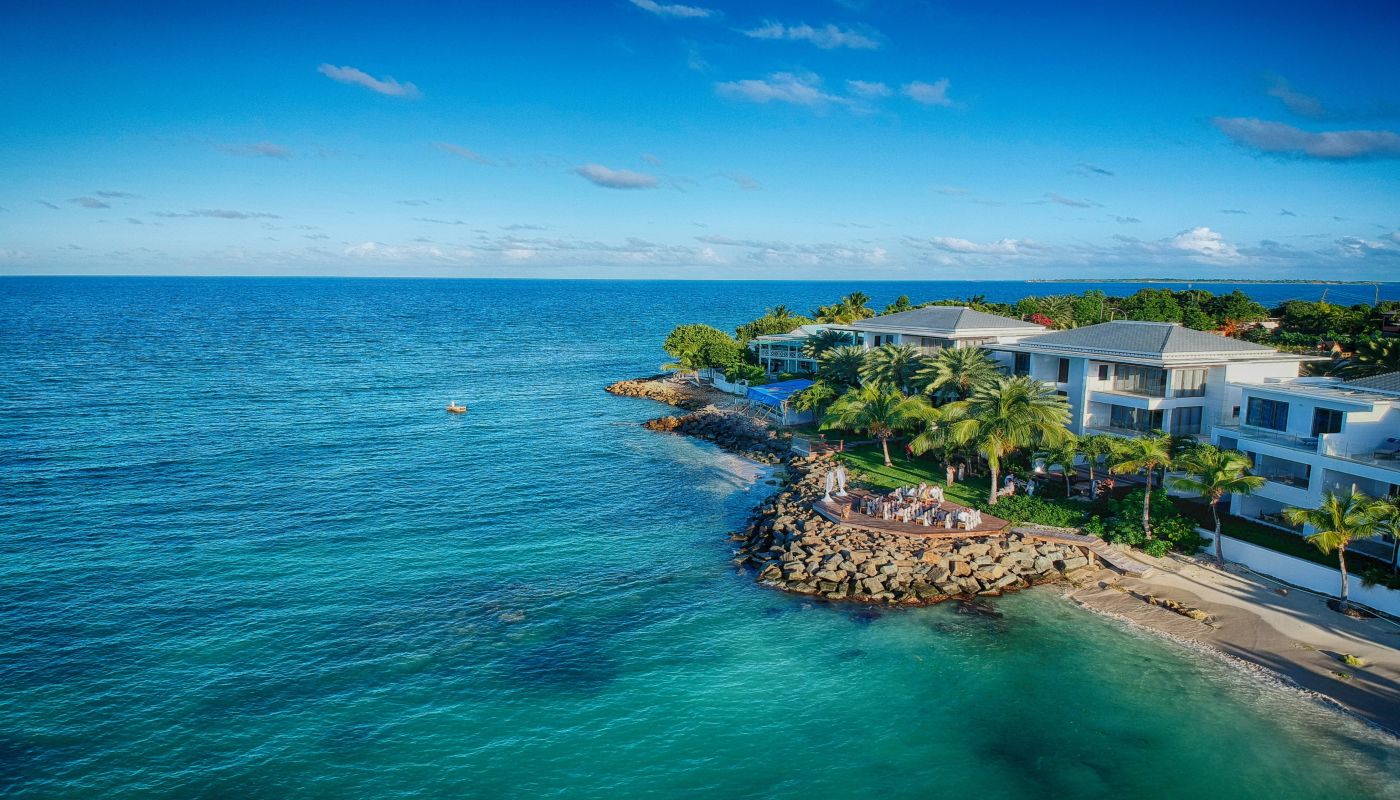
Landscape of Antigua and Barbuda
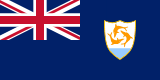
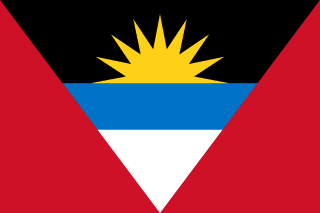
Flag of Antigua and Barbuda

Antigua and Barbuda

North America

Antigua and Barbuda operates as a parliamentary democracy, and has been an independent commonwealth underneath the United Kingdom since 1981. The British monarch is represented by an appointed governor on the islands, who acts as the head of state alongside the prime minister.1 The islands are home to a number of lizard, snake and bird species that are endemic to the islands, or are threatened species, including the Antiguan racer snake.2 When Hurricane Irma and Maria hit Barbuda in 2017, the island’s population evacuated to neighboring Antigua; 90 percent of the structures on Barbuda were completely destroyed.3 1 https://www.cia.gov/library/publications/the-world-factbook/geos/ac.html 2 https://www.fauna-flora.org/countries/antigua-barbuda 3 https://www.unicef.org/infobycountry/antiguabarbuda_100828.html

What would you like to learn about in Antigua and Barbuda?

Select a section to explore the country where nonprofits are creating positive change.

About Antigua and Barbuda

The Siboney were the first people to inhabit the islands of Antigua and Barbuda in 2400 B.C., but Arawak Indians populated the islands when COLUMBUS landed on his second voyage in 1493. Early Spanish and French settlements were succeeded by an English colony in 1667. Slavery, established to run the sugar plantations on Antigua, was abolished in 1834. The islands became an independent state within the British Commonwealth of Nations in 1981.

Quick Facts

Population
90,156 (July 2013 est.)
Area
442.6 sq km (Antigua 280 sq km; Barbuda 161 sq km)
ISO Code
AG
Continent
North America
Government
constitutional monarchy with a parliamentary system of government and a Commonwealth realm
Active Causes
12
View all countries in North America

Geography & Environment

Climate

tropical maritime; little seasonal temperature variation

Terrain

mostly low-lying limestone and coral islands, with some higher volcanic areas

Natural Resources

NEGL; pleasant climate fosters tourism

Environmental Issues

water management - a major concern because of limited natural freshwater resources - is further hampered by the clearing of trees to increase crop production, causing rainfall to run off quickly

People & Society

75.91 years
Avg. Life Expectancy
99%
Literacy Rate
30% of total population (2010)
Total Urban Population

Languages

English (official), local dialects

Religions

Protestant 76.4% (Anglican 25.7%, Seventh-Day Adventist 12.3%, Pentecostal 10.6%, Moravian 10.5%, Methodist 7.9%, Baptist 4.9%, Church of God 4.5%), R...

Health Expenditure

6% of GDP (2010) of GDP

Education Expenditure

2.5% of GDP (2009) of GDP

Economy

$18,300
GDP per Capita (PPP)
11%
Unemployment Rate
NA%
Below Poverty Line

Economic Overview

Tourism continues to dominate Antigua and Barbuda's economy, accounting for nearly 60% of GDP and 40% of investment. The dual-island nation's agricultural production is focused on the domestic market and constrained by a limited water supply and a labor shortage stemming from the lure of higher wages in tourism and construction. Manufacturing comprises enclave-type assembly for export with major products being bedding, handicrafts, and electronic components. Prospects for economic growth in the medium term will continue to depend on tourist arrivals from the US, Canada, and Europe and potentia...

Causes in Antigua and Barbuda

Environment

90 percent of the structures on Barbuda were completely destroyed by Hurricane Irma and Maria in 2017. Hurricane Jose threatened to hit Barbuda soon after Irma, but eventually passed by, though the entire island had already been evacuated to neighboring Antigua.1 Barbuda is known for its beaches of pink sand,2 and both Antigua and Barbuda are home to a wide variety of wildlife.3 Both islands are also party to a number of international environmental policies including agreements on biodiversity, climate change, desertification, endangered species, environmental modification, hazardous wastes, marine dumping and whaling.4

Family

Though Antigua and Barbuda have legislature in place to protect victims of domestic violence1 the UNHCR reports that domestic violence is a prominent issue in Antigua and Barbuda, but no studies have been conducted to procure statistics on the number of women specifically experiencing abuse.2 However, in a study conducted in 2010 in a number of Caribbean nations, 15.7 percent of participants in Antigua and Barbuda stated that they had experienced some form of physical violence at the hand of a household member.3

Human Rights

Prior to Hurricane Irma, land on Barbuda was communally owned — and has been since 1834 when slavery was abolished by Britain in the former colony. However, reconstruction efforts on the island have resulted in the introduction of the Barbuda Land Act, which would end the communal property, laissez faire policy and implement new property laws and infrastructure.

Education

Primary school enrollment in Antigua and Barbuda is 87.6 percent.1 The literacy rate is 99 percent, and children are in school for an average of 14 years.2 The Antiguan and Barbudan education systems are modeled after the British education system, and education is free and compulsory for children ages 5 to 16.3 Education accounts for just 2.5 percent of the Antiguan and Barbudan GDP.4 After Hurricane Irma hit Barbuda in 2017, Barbudan children whose families evacuated to Antigua were not eligible to attend school. Instead, a program run by UNICEF’s Return to Happiness program offered educational and recreational services for Barbudan children.5

Poverty

There is no reliable data available on the percentage of the population below the poverty line.1 However, much of the island of Barbuda is still recovering from Hurricanes Irma and Maria, as is Antigua.2

Religion

Antigua and Barbuda are predominantly Christian. Nearly 70 percent of the population identifying as Christian with Anglicanism representing the largest Christian denomination at 17 percent.1 The remainder of the islands population identifies as Roman Catholic, and 12 percent identify as other.2

Clean Water

Approximately 98 percent of Antigua and Barbuda have access to improved drinking water and 91 percent have access to modern sanitation infrastructure.1 Hurricane Irma destroyed a majority of Barbuda’s infrastructure in 2017 and the island is still rebuilding.2 Hurricane Maria’s landfall also impacted Antigua and Barbuda in 2017.3

Economy

The economy of Antigua and Barbuda is centered around tourism, and the service industry provides the majority of employment opportunities on the island. Tourism accounts for almost 60 percent of the GDP and 40 percent of investments.1 Cotton, fruits, vegetables, bananas, coconuts, cucumbers, mangoes, sugarcane and livestock are the most common agricultural products. Yet economic growth is centered primarily on the ebb and flow of tourism from North America and Europe.4 Natural disasters negatively affect the Antiguan and Barbudan economy as they inhibit tourism. In recent years, the government has taken steps to diversify the economy by introducing more transportation, communication, and financial services.5 Latest estimates on unemployment in Antigua and Barbuda project a rate of 11 percent.6 There is no reliable data for the population beneath the poverty line.7

Government

Antigua and Barbuda operates as a parliamentary democracy, and has been an independent commonwealth underneath the United Kingdom since 1981. The British monarch is represented by an appointed governor on the islands, who acts as the head of state alongside the prime minister.1

Health

The health sector of Antigua and Barbuda accounts for 5.5 percent of the GDP.1 Approximately 98 percent of Antigua and Barbuda have access to improved drinking water and 91 percent have access to modern sanitation infrastructure.2 The infant mortality rate is 12 deaths per 1,000 live births.3

Children

When Hurricane Irma hit Barbuda in 2017, the island’s population evacuated to neighboring Antigua; 90 percent of the structures on Barbuda were completely destroyed. Barbudan children were not eligible to attend school in Antigua, but a program run by UNICEF, Return to Happiness, offered educational and recreational services for the children.1 Children account for 23 percent of the Antiguan and Barbudan population,2 and in the peak of the hurricane crisis, 39,000 children were estimated to be in need, according to the UNDP.3

Animals

Antigua and Barbuda are home to a number of lizard, snake and bird species that are endemic to the islands, or are threatened species, including the Antiguan racer snake. Many of the nation’s forest were destroyed in the colonial era, eliminating habitat for the islands’ wildlife.1 Invasive rat and goat populations were introduced by guano miners in the 19th century, and have threatened some of the species native to the islands.2 When Hurricane Irma hit Barbuda in 2017, the island’s population evacuated to neighboring Antigua; 90 percent of the structures on Barbuda were completely destroyed.

Nonprofits Working in Antigua and Barbuda

Discover organizations making a difference in Antigua and Barbuda

Make Your Impact Today

Discover causes you care about and support the nonprofits making a difference in communities around the world.

Are you a nonprofit? Join Project World Impact for free

Join Us Free