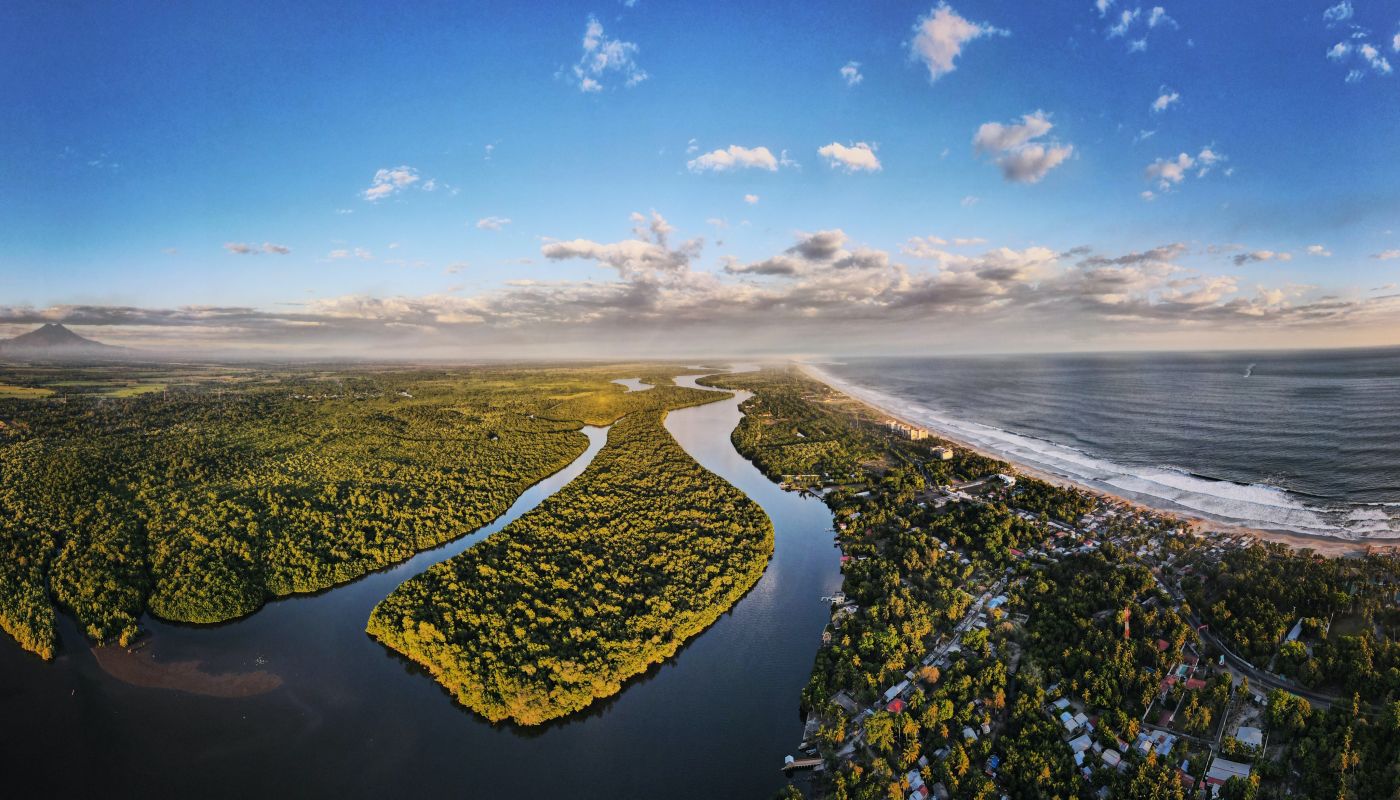
Landscape of El Salvador
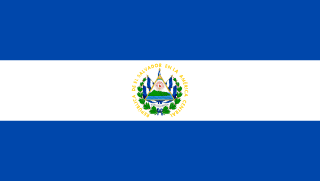
Flag of El Salvador

El Salvador

North America

Previously colonized by Spain and later the Central American Federation, the country of El Salvador gained independence in 1839. The country is marked by extreme amounts of gang activity and violence. Child labor, poverty, and water pollution are some of the major issues facing the government. There are also extremely low retention rates in the school system, with very few students moving on to receive secondary education.1 1 https://www.cia.gov/library/publications/the-world-factbook/geos/es.html

What would you like to learn about in El Salvador?

Select a section to explore the country where nonprofits are creating positive change.

About El Salvador

El Salvador achieved independence from Spain in 1821 and from the Central American Federation in 1839. A 12-year civil war, which cost about 75,000 lives, was brought to a close in 1992 when the government and leftist rebels signed a treaty that provided for military and political reforms.

Quick Facts

Population
6,108,590 (July 2013 est.)
Area
21,041 sq km
ISO Code
SV
Continent
North America
Government
republic
Active Causes
12
View all countries in North America

Geography & Environment

Climate

tropical; rainy season (May to October); dry season (November to April); tropical on coast; temperate in uplands

Terrain

mostly mountains with narrow coastal belt and central plateau

Natural Resources

hydropower, geothermal power, petroleum, arable land

Environmental Issues

deforestation; soil erosion; water pollution; contamination of soils from disposal of toxic wastes

People & Society

73.93 years
Avg. Life Expectancy
84.5%
Literacy Rate
64% of total population (2010)
Total Urban Population

Languages

Spanish (official), Nahua (among some Amerindians)

Religions

Roman Catholic 57.1%, Protestant 21.2%, Jehovah's Witnesses 1.9%, Mormon 0.7%, other religions 2.3%, none 16.8% (2003 est.)

Health Expenditure

6.9% of GDP (2010) of GDP

Education Expenditure

3.4% of GDP (2011) of GDP

Economy

$7,600
GDP per Capita (PPP)
6.9%
Unemployment Rate
36.5% (2010 est.)
Below Poverty Line

Economic Overview

The smallest country in Central America geographically, El Salvador has the third largest economy in the region. With the global recession in 2009, real GDP contracted by 3.1%. The economy slowed even further during 2010-12. Remittances accounted for 17% of GDP in 2011 and were received by about a third of all households. In 2006, El Salvador was the first country to ratify the Dominican Republic-Central American Free Trade Agreement (CAFTA-DR), which has bolstered the export of processed foods, sugar, and ethanol, and supported investment in the apparel sector amid increased Asian competition...

Causes in El Salvador

Environment

El Salvador faces many environmental problems due to limited regulations and lack of education about environmental awareness. In light of widespread poverty and civil strife, the government has prioritized economic growth and political stability in recent years.1 Closely linked with the problem of water is the problem of deforestation. Forest cover has largely been destroyed and has made land and water sources more vulnerable to desertification.2 Another legitimate environmental concern is El Salvador’s vulnerability to natural disasters like earthquakes, volcanoes, and floods.3 Additionally, the country’s natural water supplies are frequently corrupted by pollutants from factories and inadequate waste disposal.4

Family

Domestic abuse and violence against women are rampant problems in El Salvador. Two-thirds of reported sexual crimes are committed against children under the age of 18. Rates of child marriage contribute to the rising rates of domestic abuse.1 6% of girls in the country are married by age 15 and 26% are married before or by age 18.2 El Salvador has been consistently ranked as one of the most deadly countries for women. Seven out of every 10 women that is sexually or violently attacked is under the age of 20. Officials believe that a major contributor to the levels of violence against women is the amount of gang activity.3

Human Rights

The greatest human rights violations in El Salvador include the use of extrajudicial force, and discrimination against women and migrants.1 While amnesty was granted for human rights violations committed by authorities, continued impunity is considered to be a major issue. More recently, the pressing matter of unaccompanied children immigrating to the United States has become a human rights concern.2 There were around 3,400 reported homicides reported in the first six months of 2016, compared to 3,500 total reported in 2015. This is attributed mainly to an increase of gang violence in the country.3

Education

The largest challenges to the El Salvadoran education system are the poor overall quality of education, the limited access to educational facilities, under-resourced educational facilities, and school desertion due to students joining gangs or the workforce.1 Additionally, chronic malnutrition, which affects 25% of El Salvador’s children, makes it more difficult for children to be productive and alert in school.2 One of the struggles the government faces is the low enrollment rates for secondary education (grades 7-9). Only 50-60% of children continue on to grades to secondary education. Often the cost of uniforms and supplies is too high, which leads to children dropping out of school.2 The country’s literacy rate is 88%.3

Poverty

Roughly 35% of the population of El Salvador lives in poverty. Income inequality and limited earning potential are exacerbated by limited educational opportunities, poor access to healthcare, and natural disasters.1 Each of these factors place additional strain on tight budgets and can force individuals living on the brink of poverty into complete poverty. The country is largely dependent on foreign aid, with the largest supplier of this aid being the United States. This presents dangers to the country as it renders El Salvador vulnerable to shocks in both its domestic economy and foreign economies.2 The country’s unemployment rate is at 6.3%.3

Religion

El Salvador’s constitution provides for the protection and preservation of religious freedom. Furthermore, there are additional provisions stipulating there shall be no discrimination based on race, nationality, gender, or religious affiliation. The constitution does, however, require that leaders of the government such as the president, cabinet ministers, supreme court justices, and others be laypersons.1 Census data reveals that 50% of El Salvadoran citizens identify as Roman Catholics, 36% identify as Evangelical Christians, and 14% claim no religious affiliation.2

Clean Water

While El Salvador has substantial natural water resources, large portions of the country’s natural water sources are contaminated by fecal matter and pollutants. Many industries do not monitor the pollutants they emit into lakes and streams. It is estimated that over 500 children per year die as the result of poor water quality.1 94% of the population has access to improved water sources. Only 75% of the population has access to improved sanitation facilities.2 The country is nearing the indicators that would name it a “water-stressed” country, but this problem is exacerbated by the fact that private companies can use unlimited water without regard for the effect on local communities.3

Economy

El Salvador’s economy struggles with corrupt political interference, the aftereffects of natural disasters, and income inequality.1 While the judiciary is independent, it is susceptible to corruptive influence and few crimes are prosecuted when high-ranking officials are involved.2 Natural disasters, particularly earthquakes, have been particularly detrimental to the functioning of the economy, as businesses must expend extra resources to rebuild or restore capital, and individuals may have additional household and transportation expenses in the wake of a natural disaster.3 Furthermore, approximately 35% of El Salvadorans live below the poverty line. The unemployment rate is at 7%.4

Government

The Republic of El Salvador is a presidential republic. The government is marked by widespread corruption. Public officials rarely face consequences for crimes they allegedly commit. Additionally, the justice system, while independent, is vulnerable to corruptive influence and obstructionism. Violent crime is also undermining the efficacy of the government and the economy.1 Transparency International ranks the country 95th out of 176 countries, and the Salvadoran people score their government 36 out of 100.2

Health

In light of natural disasters, pollution, poor water quality, and widespread poverty, El Salvador’s citizens face a number of health risks exacerbated by environmental conditions and a lack of access to healthcare. It is estimated that 78% of El Salvadorans do not have public or private health insurance, and nearly 42% of citizens face limitations in accessing health care. Anemia, chronic malnutrition, and stunted growth have alarmingly high prevalence among young children, and obesity is widespread among adults.1 The average life expectancy in El Salvador is 72 years of age.2 The maternal mortality rate is 54 deaths for every 100,000 live births, and the infant mortality rate is 17 deaths for every 1,000 live births.3

Children

Due to extreme poverty and civil strife in El Salvador, children face many obstacles to their development such as malnutrition, limited access or ability to attend schools, limited access to health facilities, and gang activity. Approximately 25% of all El Salvadoran children under the age of 5 are chronically malnourished.1 Furthermore, gang activity and youth violence have reached dangerous levels. Worsening conditions have spurred many adults to send their children to the United States in order to protect them from the violence.2 Child labor is also a threat to children’s well being in El Salvador, and approximately 6% of children ages 5 to 14 are involved in the labor force. Over 8,000 children are used to harvest sugarcane and coffee and are exposed to long workdays, toxins, and injuries from sharp knives and machetes.3

Animals

El Salvador is part of the Neotropical region on the Pacific Coast. There are over 200 species native to this area, and around 70 are threatened or endangered. El Salvador is home to some of the most important nesting grounds for birds like the white-fronted parrot and yellow-naped parrot. Some major threats to the region include deforestation and the degradation of the soil due to pollution from fertilizers and mismanagement of industrial waste.1

Nonprofits Working in El Salvador

Discover organizations making a difference in El Salvador

NPH USA

NPH USA

NPH USA transforms the lives of orphaned, abandoned and disadvantaged children in Latin America and the Caribbean by supporting the homes, healthcare and educational programs of Nuestros Pequeños Hermanos (NPH, Spanish for "Our Little Brothers and Sisters"). Together, we create families for life and teach children the values of unconditional love, shared responsibility and helping others. Our donors help children overcome poverty and become leaders in their own communities. Since its founding in 1954, NPH has assisted more than 20,000 children and is currently raising more than 3,400 boys and girls in Bolivia, the Dominican Republic, El Salvador, Guatemala, Haiti, Honduras, Mexico, Nicaragua and Peru. An additional 1,600 students who live outside the homes receive scholarships, meals and health care. NPH outreach programs provided over 95,000 services in 2014.

Chicago, Illinois

Make Your Impact Today

Discover causes you care about and support the nonprofits making a difference in communities around the world.

Are you a nonprofit? Join Project World Impact for free

Join Us Free