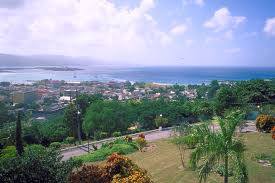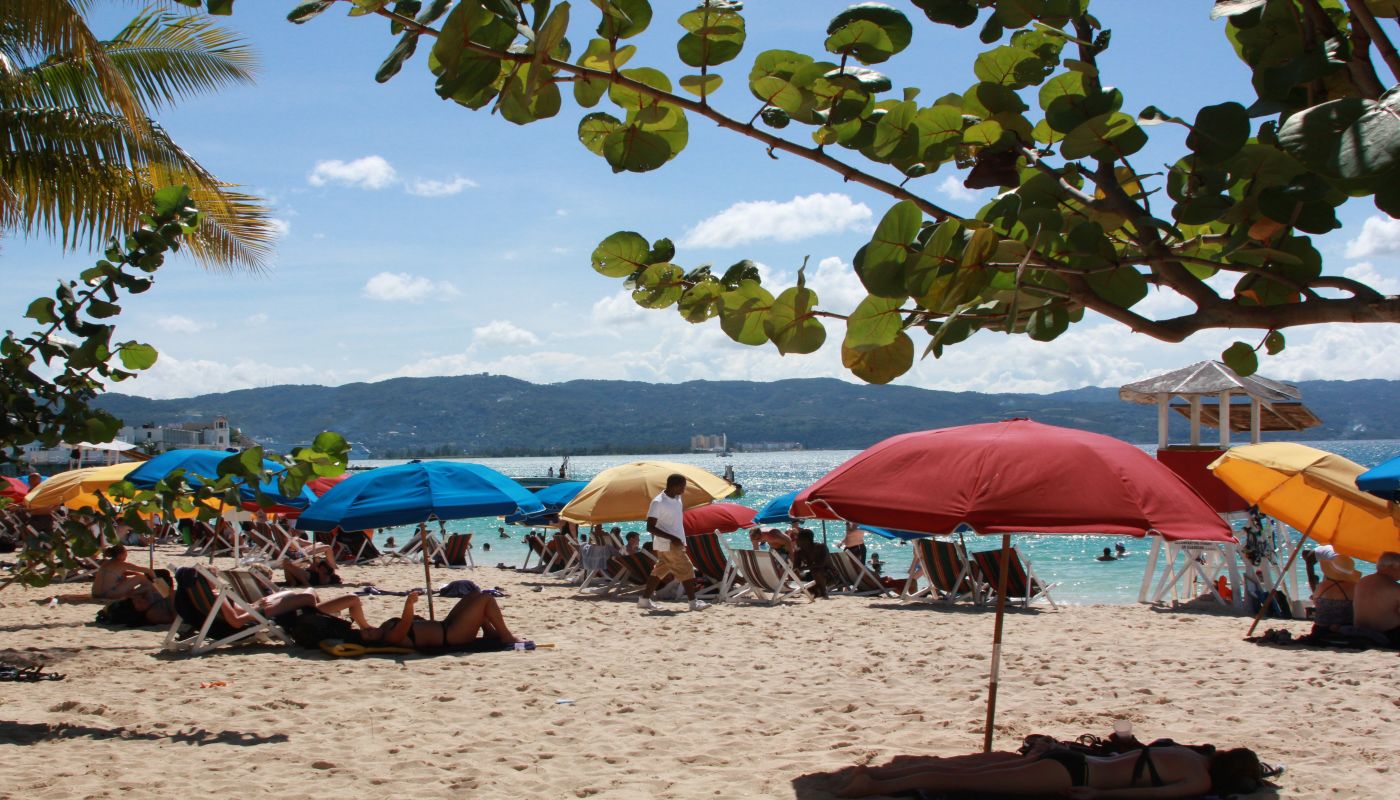
Landscape of Jamaica
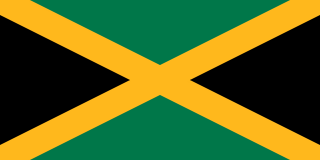
Flag of Jamaica

Jamaica

North America

Jamaica was inhabited originally by native Taino people who were eventually killed off completely during Spanish colonization. After being taken over by England, Jamaica gained full independence in 1962. Rampant drug and human trafficking, gang violence, and poverty cause large issues for the Jamaican government. The financial dependency of all Jamaicans on the tourism sector causes the resort areas in the country to remain relatively safe from gang violence, although they continue to be centers for child and adult trafficking.1 https://www.cia.gov/library/publications/the-world-factbook/geos/jm.html

What would you like to learn about in Jamaica?

Select a section to explore the country where nonprofits are creating positive change.

About Jamaica

The island - discovered by Christopher COLUMBUS in 1494 - was settled by the Spanish early in the 16th century. The native Taino, who had inhabited Jamaica for centuries, were gradually exterminated and replaced by African slaves. England seized the island in 1655 and established a plantation economy based on sugar, cocoa, and coffee. The abolition of slavery in 1834 freed a quarter million slaves, many of whom became small farmers. Jamaica gradually increased its independence from Britain. In 1958 it joined other British Caribbean colonies in forming the Federation of the West Indies. Jamaica gained full independence when it withdrew from the Federation in 1962. Deteriorating economic conditions during the 1970s led to recurrent violence as rival gangs affiliated with the major political parties evolved into powerful organized crime networks involved in international drug smuggling and money laundering. Violent crime, drug trafficking, and poverty pose significant challenges to the government today. Nonetheless, many rural and resort areas remain relatively safe and contribute substantially to the economy.

Quick Facts

Population
2,909,714 (July 2013 est.)
Area
10,991 sq km
ISO Code
JM
Continent
North America
Government
constitutional parliamentary democracy and a Commonwealth realm
Active Causes
12
View all countries in North America

Geography & Environment

Climate

tropical; hot, humid; temperate interior

Terrain

mostly mountains, with narrow, discontinuous coastal plain

Natural Resources

bauxite, gypsum, limestone

Environmental Issues

heavy rates of deforestation; coastal waters polluted by industrial waste, sewage, and oil spills; damage to coral reefs; air pollution in Kingston from vehicle emissions

People & Society

73.44 years
Avg. Life Expectancy
87%
Literacy Rate
52% of total population (2010)
Total Urban Population

Languages

English, English patois

Religions

Protestant 62.5% (Seventh-Day Adventist 10.8%, Pentecostal 9.5%, Other Church of God 8.3%, Baptist 7.2%, New Testament Church of God 6.3%, Church of G...

Health Expenditure

4.8% of GDP (2010) of GDP

Education Expenditure

6.4% of GDP (2010) of GDP

Economy

$9,300
GDP per Capita (PPP)
14.3%
Unemployment Rate
16.5% (2009 est.)
Below Poverty Line

Economic Overview

The Jamaican economy is heavily dependent on services, which accounted for more than 60% of GDP at the end of 2011. The country continues to derive most of its foreign exchange from tourism, remittances, and bauxite/alumina. Remittances account for nearly 15% of GDP and exports of bauxite and alumina make up roughly 5%. The bauxite/alumina sector was most affected by the global downturn while the tourism industry was resilient. Tourism revenues account for roughly 5% of GDP in 2011. Jamaica's economy faces many challenges to growth: high crime and corruption, large-scale unemployment and under...

Causes in Jamaica

Environment

Jamaica’s economy is highly dependent on its tourism sector, which depends on the island’s biodiversity. Thus, climate change has serious consequences for the island and its economy. The threat of climate change was recognized and addressed in the government’s Vision 2030 Jamaica: National Development Plan and the proper adaptation plans have been outlined.2 Jamaica produces 13 million metric tons of carbon emissions annually.3

Family

Last year, the United Nations Committee on Economic, Social, and Cultural rights expressed concern for the high rates of sexual violence and domestic violence that are present in Jamaica. The cultural acceptance of domestic violence is high and spousal abuse is perpetuated by a societal norm that prevents women from reporting all the instances of abuse to authorities. Although there is a Sexual Offences Act, it fails to protect women in certain cases of marital rape. Over 470 women and girls reported rape in 2016.1 Although more needs to be done, Jamaica does currently have a law that outlaws domestic abuse and it also allows those who have been victims of the abuse to seek legal protection.2 Child trafficking is a prevalent issue facing the Jamaican government; the country is both a source and destination for human trafficking.3 Housing and property rights issues have resulted in nearly 20% of the population living as squatters.4

Human Rights

Among Jamaica’s most prevalent human rights concerns are the relative freedom of police forces to commit extrajudicial executions, and violence and discrimination against gay, lesbian, transgender, and intersex people. Children are frequently detained illegally in poor conditions and in the same facilities as adults, for illegal amounts of time.1 Another significant concern in Jamaica is the extremely high rate of violent homophobia that is present. There is no section of the law that provides protection against same-gender rape.2 Domestic abuse in the country also continues to be a problem. 470 women or girls reported rape in 2016. 3 Although there is room for improvement, Jamaica does have a law that outlaws domestic abuse, and it also allows those who have been victims of the abuse to seek legal protection.4

Education

Currently Jamaica faces serious obstacles in the provision of quality schools and opportunities. The largest challenges are reaching children in poor urban areas and developing programs and infrastructure for children with disabilities. 25% of children in the poorest quintile of the country drop out of school by the age of 16.1 The primary school attendance rate in Jamaica is at 98%; however, the completion rate is only at 73%. This is due to the high rates of child labor in the country and the number of children who drop out of school to work.2 Jamaica’s overall adult literacy rate is low at 87%.3

Poverty

The unemployment rate in Jamaica over is 12.8% of the population.1 The education system is failing many students who either do not graduate from secondary school or who do not leave with a quality education that would prepare them for employment.2 Currently, 16.5% of Jamaicans live below the international poverty line.3 The government has made progress towards eradicating poverty in Jamaica as part of its Millennium Development Goals, but poverty within Jamaica has become institutionalized. The high rates of poverty have led to an increase in the illegal drug trade and gang violence.4

Religion

Jamaica is an overwhelmingly Christian country with 64.8% of the population belonging to the Protestant denomination. The rest of the population follows various other Christian denominations such as Pentecostal, Baptist, Church of God, Methodist, and Roman Catholic.1 Jamaica’s constitution protects religious freedom and this is generally enforced. Reports of religious conflict or discrimination are generally nonexistent.2

Clean Water

Currently, 94% of Jamaica’s population has access to improved drinking water supplies and only 80% of the population has access to improved sanitation infrastructure. The improved water accessibility rate is lower in rural areas, where 90% of the population has access.1

Economy

The backbone of Jamaica’s economy is the service industry, which accounts for almost 72% of the total GDP. Agriculture makes up only 7% of the national income, but accounts for 17% of the labor force. The majority of the foreign exchange that happens in Jamaica is in the form of tourism, remittances, and bauxite. The major challenges that face the overall growth of the economy are high crime rates, widespread corruption, unemployment, and underemployment. Jamaica’s public debt is 127% of GDP. Jamaica is currently unable to finance the necessary reforms for improving infrastructure and social programs, since the vast majority of funds go towards relieving the large debt.1 There was and still is a high rate of government spending towards economic bailouts of certain areas of the economy, and the public sector is overextended. If Jamaica hopes to reduce its debt and public sector, it is necessary to privatize large amounts of enterprises.2 The unemployment rate in Jamaica is currently at 13%.3

Government

The government of Jamaica is both a monarchy in a constitutional parliamentary democracy and a Commonwealth realm. The chief of state is Queen Elizabeth II, who is represented by an appointed Governor, and the head of government is a prime minister. The three main political parties are the Jamaica Labor Party, People’s National Party, and the National Democratic Movement.1 Jamaica recently signed an agreement with the IMF for $1.2 billion standby to help support the payment of the government debt, but the meaningful reforms for that policy have yet to materialize as of 2018. The government also faces challenges with the illegal drug trade and the rise of violent crime.2 Corruption continues to pervade various aspects of Jamaica’s government, and a Transparency International survey shows that the public scores the government 39 out of 100 for perceived corruption.3 There are various human rights abuses reportedly perpetrated by the police forces. The police have not been prosecuted for their actions during the state of emergency in 2010.4

Health

Jamaica’s health sector needs more cohesive and supportive legislation in order to reach its full potential. The pharmacovigilance within the country is poor. There have also been many improvements in programs that seek to combat the effects of HIV/AIDS. However, non-communicable diseases continue to account for a large majority of all fatalities.1 There has also been a rise in the amount of illegal drug use and trade. The government of Jamaica is moving towards decriminalizing marijuana usage in the country.2 Life expectancy is 75, and infant mortality rates are 12.8 deaths per 1,000 live births. Maternal mortality rates are 89 deaths per 100,000 live births.3

Children

The child protection and welfare services in Jamaica have historically been uncoordinated and ineffective. When Jamaica became party to the UN Convention on the Rights of the Child, it created a much more cohesive system, increasing focus on child development.1 In 2016, Amnesty International reported children being retained in police lockups for illegal amounts of time, and in extremely poor conditions.2 38% of youth between ages 15-24 are unemployed3, but approximately 8.4% of Jamaica’s children ages 5 to 14 are involved in the labor force. Additionally, children on the island are often forced into prostitution at several of the island’s tourist resorts. Jamaica’s primary school enrollment rate is at 98%.4

Animals

Jamaica’s tropical climate allows for the flourishing of many species in its small area of land. The mangrove tree is one of the most important parts of the native flora, as it protects the island’s wildlife from the often extreme tropical weather and prevents damaging storms from stripping the island’s beaches. Jamaican waters are host to the Cuban crocodile, the upside-down jellyfish, and a variety of types of starfish. The habitats of these species are threatened by illegal logging, expansion of tourist areas, and irresponsible disposal of waste into the ocean.1

Nonprofits Working in Jamaica

Discover organizations making a difference in Jamaica

Make Your Impact Today

Discover causes you care about and support the nonprofits making a difference in communities around the world.

Are you a nonprofit? Join Project World Impact for free

Join Us Free