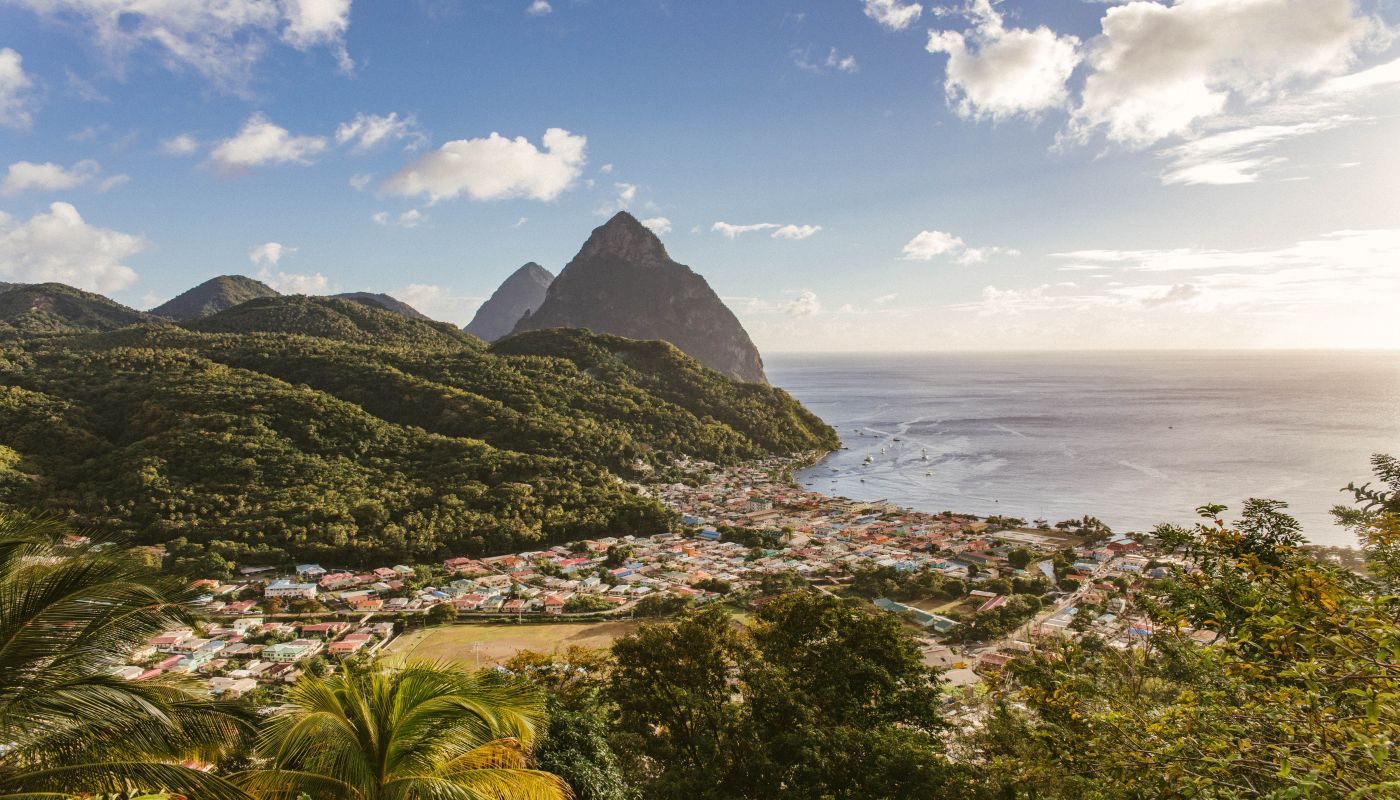
Landscape of St. Lucia
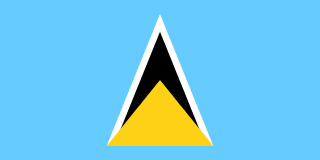
Flag of St. Lucia

St. Lucia

North America

Saint Lucia is an island nation in the southern Caribbean sea. It is an independent nation, but also a member of the British Commonwealth which gives it a loose association with the United Kingdom with Queen Elizabeth as head of state.1 Once a hub in the transatlantic slave trade, agriculture and tourism remain the two most important factors in the economy.2 1 https://www.britannica.com/place/Saint-Lucia#toc55399
1 https://www.cia.gov/library/publications/the-world-factbook/geos/st.html

What would you like to learn about in St. Lucia?

Select a section to explore the country where nonprofits are creating positive change.

About St. Lucia

The island, with its fine natural harbor at Castries, was contested between England and France throughout the 17th and early 18th centuries (changing possession 14 times); it was finally ceded to the UK in 1814. Even after the abolition of slavery on its plantations in 1834, Saint Lucia remained an agricultural island, dedicated to producing tropical commodity crops. Self-government was granted in 1967 and independence in 1979.

Quick Facts

Population
162,781 (July 2013 est.)
Area
616 sq km
ISO Code
LC
Continent
North America
Government
parliamentary democracy and a Commonwealth realm
Active Causes
12
View all countries in North America

Geography & Environment

Climate

tropical, moderated by northeast trade winds; dry season January to April, rainy season May to August

Terrain

volcanic and mountainous with some broad, fertile valleys

Natural Resources

forests, sandy beaches, minerals (pumice), mineral springs, geothermal potential

Environmental Issues

deforestation; soil erosion, particularly in the northern region

People & Society

77.22 years
Avg. Life Expectancy
90.1%
Literacy Rate
28% of total population (2010)
Total Urban Population

Languages

English (official), French patois

Religions

Roman Catholic 67.5%, Protestant 18.2% (Seventh-Day Adventist 8.5%, Pentecostal 5.7%, Anglican 2%, Evangelical 2%), other Christian 5.1%, Rastafarian...

Health Expenditure

8.7% of GDP (2010) of GDP

Education Expenditure

4.4% of GDP (2011) of GDP

Economy

$13,300
GDP per Capita (PPP)
20%
Unemployment Rate
NA%
Below Poverty Line

Economic Overview

The island nation has been able to attract foreign business and investment, especially in its offshore banking and tourism industries. Tourism is Saint Lucia's main source of jobs and income - accounting for 65% of GDP - and the island's main source of foreign exchange earnings. The manufacturing sector is the most diverse in the Eastern Caribbean area. Crops such as bananas, mangos, and avocados continue to be grown for export, but St. Lucia''s once solid banana industry has been devastated by strong competition and by Hurricane Tomas in 2010. Saint Lucia is vulnerable to a variety of externa...

Causes in St. Lucia

Environment

As a densely populated island nation, the tropical island of St. Lucia faces environmental concerns stemming from the overexploitation of natural resources. These concerns include deforestation, degradation of land and soil quality, loss of habitat, and poorly implemented environmental protection legislation.1

Family

There are a large number of orphaned children because of the HIV/AIDs epidemic, which has caused many families to live with extended family members in the same household.1 Domestic violence within the family structure is a serious concern, but actual statistics are unknown due to massive underreporting.2

Human Rights

In general, human rights are respected and upheld in St. Lucia. The largest human rights concerns involve abuses of power and authority from police and security forces, delayed trials, and human trafficking.1

Education

Education is compulsory through age 16 in St. Lucia. Primary education and secondary education are both considered to be universally accessible, however, tertiary schooling still lags behind.1 The national literacy rate is at 90% and the primary school enrollment rate is at 93%.2

Poverty

There are no reliable statistics about how many people live in poverty in Saint Lucia, but estimates say it is near 20%. The high rate of poverty has caused an increase in petty theft and other small crimes.1

Religion

Religious freedom is a constitutional provision in St. Lucia and is generally upheld. Preserving religious freedom is considered an integral part of upholding human rights, and public leaders openly advocate for religious freedom.1 The island is predominantly Christian with the largest denominations being Roman Catholic at 61% of the total population and Protestants being 25%.2

Clean Water

Access to clean water is not a pressing concern in Saint Lucia. Overall, 96% of the population has access to improved water sources and 90% have access to proper sanitation infrastructure. Typically, urban centers have a higher rate of access to improved water sources whereas rural populations have a lower rate of access.1 The largest threats to clean water access in Saint Lucia are tropical storms and extreme weather events that have the potential to contaminate ground water sources.2

Economy

Saint Lucia’s economy has experienced great success in foreign investments and tourism. Tourism provides most of the island’s jobs and is also the biggest contributor to the GDP. There is an extremely high public debt which has constrained the government’s ability to further improve the economy and be resistant to external economic factors.1 The island does not notably struggle with corruption and has shown improvements regarding labor freedom. One of the largest concerns in St. Lucia is the unemployment rate; at roughly 20%, it poses a threat to the well-functioning of the economy and the contentedness of its labor force.2

Government

St. Lucia has a well-functioning and transparent government, and corruption is not a serious issue.1 There is a parliamentary structure with a prime minister as the head of government.2

Health

The country has made massive improvements to the quality of life in recent years because of increased government spending, and the life expectancy is now 78 years.1 The country has a 99% immunization coverage rate, and there have also been substantial improvements surrounding maternal health care to keep the infant mortality rate low.2 The infant mortality rate is at 11 deaths for every 1,000 live births.1

Children

Poverty is considered a major threat to the health and wellbeing of children in St. Lucia. Nearly 28% of children under the age of 15 experience poverty. The AIDS epidemic has caused many single parent households and orphaned children, giving children a lower quality of childhood.1 Around 90% of children in St. Lucia are literate and remain in school for13 years on average.2

Animals

The remote island is home to many unique mammal, bird, and reptile species like the Saint Lucia black finch and the Saint Lucia oriole.1

Nonprofits Working in St. Lucia

Discover organizations making a difference in St. Lucia

Make Your Impact Today

Discover causes you care about and support the nonprofits making a difference in communities around the world.

Are you a nonprofit? Join Project World Impact for free

Join Us Free