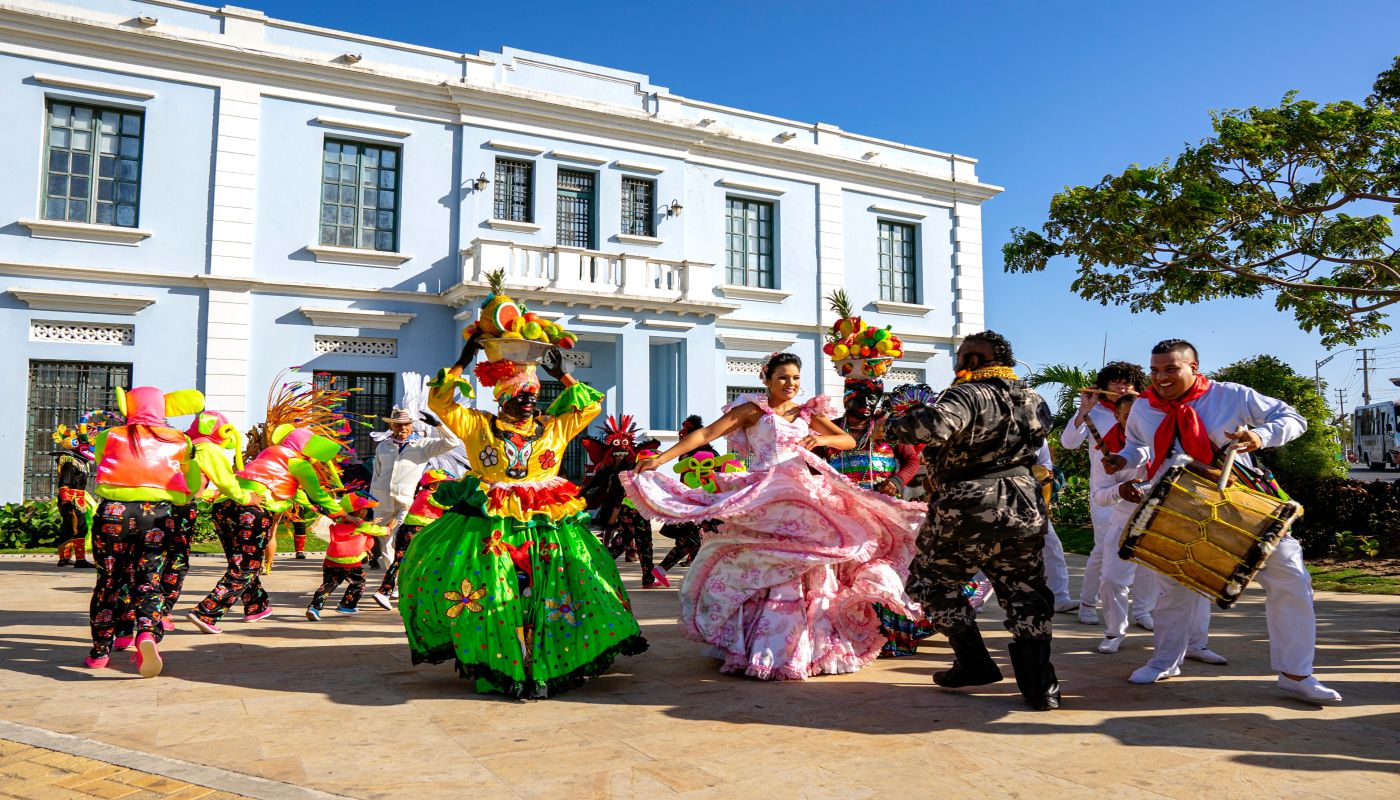
Landscape of Colombia
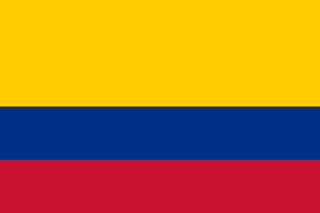
Flag of Colombia

Colombia

South America

Colombia has been independent and democratic longer than most South American countries. Colombia was plagued with internal violence for 50 years from the guerrilla group FARC (Revolutionary Armed Forces of Colombia) and the illegal drug trade, but a peace agreement was reached in 2016.1 Despite these challenges, the government has been able to remain stable and democratic to provide citizens with services. There are other challenging issues, however, because of large wealth discrepancies and high levels of poverty.2 1 https://www.britannica.com/place/Colombia
1 https://www.cia.gov/library/publications/the-world-factbook/geos/co.html

What would you like to learn about in Colombia?

Select a section to explore the country where nonprofits are creating positive change.

About Colombia

Colombia was one of the three countries that emerged from the collapse of Gran Colombia in 1830 (the others are Ecuador and Venezuela). A nearly five-decade long conflict between government forces and anti-government insurgent groups, principally the Revolutionary Armed Forces of Colombia (FARC) heavily funded by the drug trade, escalated during the 1990s. More than 31,000 former paramilitaries had demobilized by the end of 2006 and the United Self Defense Forces of Colombia as a formal organization had ceased to function. In the wake of the paramilitary demobilization, emerging criminal groups arose, whose members include some former paramilitaries. The insurgents lack the military or popular support necessary to overthrow the government, but continue attacks against civilians. Large areas of the countryside are under guerrilla influence or are contested by security forces. In October 2012, the Colombian Government started formal peace negotiations with the FARC aimed at reaching a definitive bilateral ceasefire and incorporating demobilized FARC members into mainstream society and politics. The Colombian Government has stepped up efforts to reassert government control throughout the country, and now has a presence in every one of its administrative departments. Despite decades of internal conflict and drug related security challenges, Colombia maintains relatively strong democratic institutions characterized by peaceful, transparent elections and the protection of civil liberties.

Quick Facts

Population
45,745,783 (July 2013 est.)
Area
1,138,910 sq km
ISO Code
CO
Continent
South America
Government
republic; executive branch dominates government structure
Active Causes
12
View all countries in South America

Geography & Environment

Climate

tropical along coast and eastern plains; cooler in highlands

Terrain

flat coastal lowlands, central highlands, high Andes Mountains, eastern lowland plains (Llanos)

Natural Resources

petroleum, natural gas, coal, iron ore, nickel, gold, copper, emeralds, hydropower

Environmental Issues

deforestation; soil and water quality damage from overuse of pesticides; air pollution, especially in Bogota, from vehicle emissions

People & Society

75.02 years
Avg. Life Expectancy
93.6%
Literacy Rate
75% of total population (2010)
Total Urban Population

Languages

Spanish (official)

Religions

Roman Catholic 90%, other 10%

Health Expenditure

7.6% of GDP (2010) of GDP

Education Expenditure

4.5% of GDP (2011) of GDP

Economy

$11,000
GDP per Capita (PPP)
10.4%
Unemployment Rate
34.1% (2011 est.)
Below Poverty Line

Economic Overview

Colombia's consistently sound economic policies and aggressive promotion of free trade agreements in recent years have bolstered its ability to face external shocks. Real GDP has grown more than 4% per year for the past three years, continuing almost a decade of strong economic performance. All three major ratings agencies have upgraded Colombia's government debt to investment grade. Nevertheless, Colombia depends heavily on oil exports, making it vulnerable to a drop in oil prices. Economic development is stymied by inadequate infrastructure, weakened further by recent flooding. Moreover, the...

Causes in Colombia

Environment

Colombia’s ecosystem is incredibly diverse. However, there are many threats to preserving its richness such as over-harvesting, erosion, air and water pollution, deforestation, and pollution.1 Air and water pollution caused by urbanization and industry have increased the prevalence of lung diseases and unsafe drinking water.2 These problems are serious for the poor, who are more vulnerable to environmental changes affecting their livelihood.3

Family

There is a large amount of internally displaced persons in Colombia due to conflict between the government and guerrilla groups. This conflict and drug cartels luring young people into their work, have both torn apart families.1 Culturally, the extended family is a powerful presence, providing social and financial support to one another, and often living in the same household or neighborhood.2 Approximately 37 percent of the country's women have reported instances of domestic abuse.3

Human Rights

Guerilla groups have kidnapped over 30,000 people and are known to use violence and torture to intimidate civilians. Both guerrillas and security forces have set up numerous land mines that detonate on civilians. An official peace agreement, signed in 2016, officially ended the fifty year conflict, but there are still minor skirmishes and worries about its effectiveness to protect human rights.1 Racial conflict and inequality are prevalent, with indigenous groups more often living in poverty than Colombians of European ancestry. The indigenous people also experience a disproportionate amount of violence and social discrimination.2 In addition, because of past violence, Colombia has one of the highest numbers of displaced person in the world. The government has not worked to implement strategies to return people to their homes efficiently.1

Education

Colombia’s illiteracy rate nears 20 percent in certain rural regions, but the national literacy rate is still high at 95 percent.1 Public school is free and compulsory, but many students attend private schools to get internationally competitive educations. Gender inequality reduces the likelihood of girls’ ability to pursue further education or employment, and Colombia’s institutes of higher education have extremely high dropout rates of over 45 percent.2

Poverty

Colombia has one of the world’s largest income inequalities, with over one-third of the population living below the poverty line. In rural areas, the prevalence of poverty is even higher.1 Extreme poverty makes people particularly vulnerable to Colombia’s common natural disasters. However, with decreased violence and the government regaining control of the country, poverty has been slowly decreasing while the middle class is growing.2

Religion

Catholicism was the official state until the 1990s, and over 90 percent of Colombians still identify as Catholic. The bulk of the remaining population practice other forms of Christianity, and there are small minority groups following Islam, Judaism, and traditional indigenous religions.1 Now, freedom of religion is guaranteed, but religious institutions must register with the government. There are very few instances of religious discrimination reported. However, some guerrilla groups have attacked religious leaders in order to promote their agenda.2

Clean Water

Colombia’s water system does not provide adequate access to all its citizens, and those in poor areas are most vulnerable to water issues, with 27 percent of the rural population without access to clean water and 35 percent without access to improved sanitation infrastructure.1 Watersheds have not been managed well in the past to productively utilize the freshwater supply, resulting in a shortage of clean water available to all. Water pollution also seriously compromises the quality of available drinking water.2

Economy

Columbia has the third largest economy in Central and South America.1 There is a significant amount of natural resources available for extraction and subsistence farming is still common, with the agricultural sector employing 17 percent of the labor force. Other large contributors to the GDP are the energy and mining industries. Still, the economy remains hampered by inefficient management policies which leaves unemployment near 10 percent.2

Government

Colombia has been independent from Spain since 1819 and is a presidential democratic republic. There has been a low intensity internal conflict inflicting the country since the 1960s, and the main guerrilla group is called the FARC.1 These guerillas are linked to the illegal drug trade and destabilize political and civil liberties. There have been many accusations of political corruption and leaders colluding with the guerillas. Even without these insurgent groups, the government has immense corruption levels. Most corruption occurs in mid-level governmental officials in the form of bribes or graft.2

Health

The life expectancy in Colombia is 78. While there have been improvements in the healthcare industry, there are huge differences in quality of care between social classes. Colombia has one of the highest levels of wealth inequality in the world, and for those at the bottom, health care is still inaccessible.1 Maternal and infant health is significantly worse than in similarly developed countries, and the infant mortality rate is 18 deaths per 1,000 live births.2

Children

Child exploitation and labor are a serious problem in Colombia with 13 percent of children involved in child labor.1 In addition to this, nearly 35,000 young women and girls are trafficked into slavery each year.2 Child marriage is a problem, and 6 percent of girls are married by age 15 and 23 percent by age 18.3

Animals

With coasts on both the Caribbean Sea and the Pacific Ocean, the Andes mountains, and low lying rainforests, Colombia boasts a plethora of diverse wildlife. In particular, animal life is extremely rich and diverse on the Pacific Coast and in the Amazon region, and many Western zoos capture animals like anteaters, monkeys, and sloths from these forested areas.1 Some of the challenges the animal population faces are growing urbanization, increased tourism, and resource extraction.2

Nonprofits Working in Colombia

Discover organizations making a difference in Colombia

Make Your Impact Today

Discover causes you care about and support the nonprofits making a difference in communities around the world.

Are you a nonprofit? Join Project World Impact for free

Join Us Free