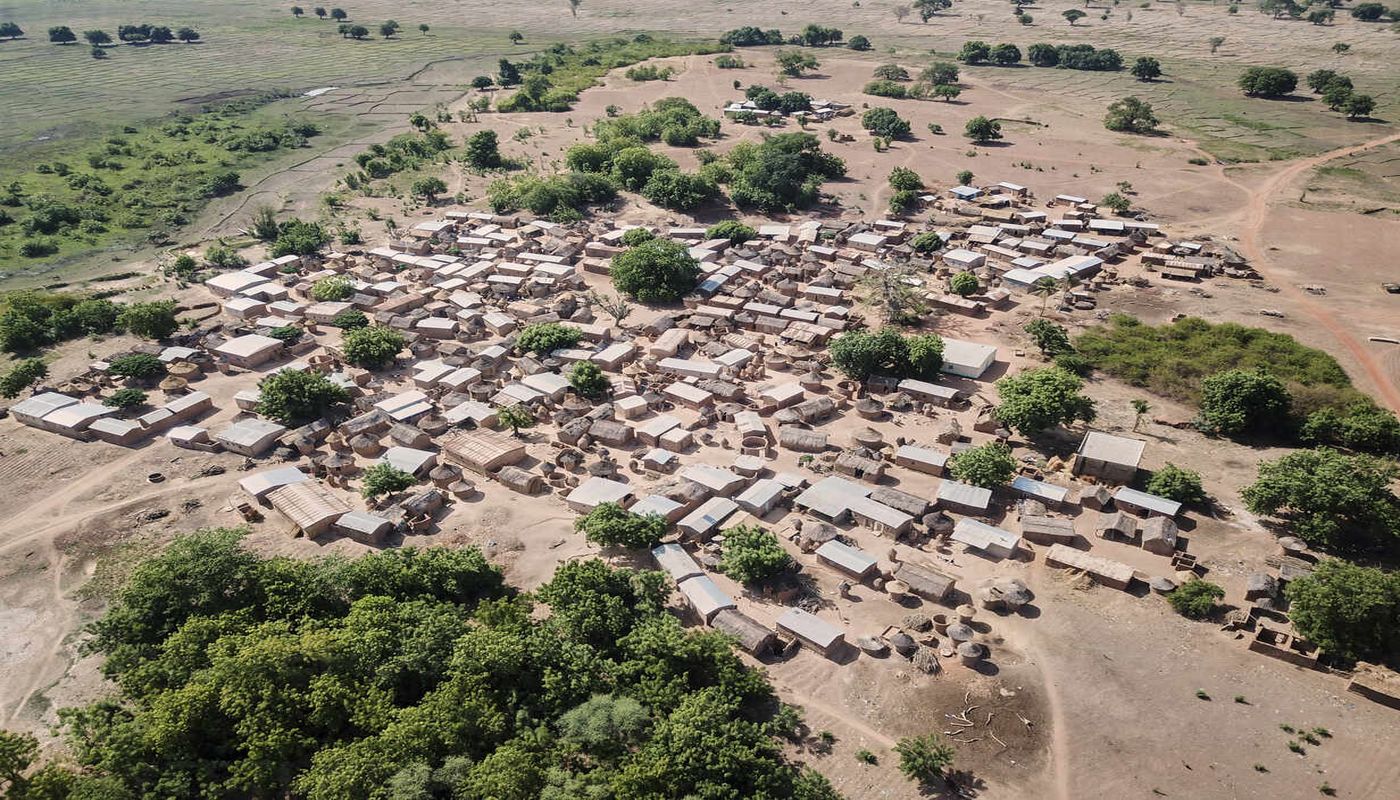
Landscape of Burkina Faso
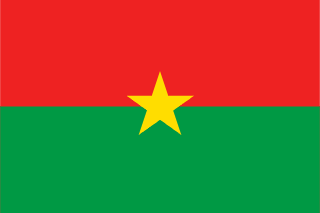
Flag of Burkina Faso

Burkina Faso

Africa

A former French colony, Burkina Faso gained its independence in 1960, and until then was known as Upper Volta. Numerous military coups through the 1970s and 80s ended with multi-partisan elections in the 1990s. The capital of Ouagadougou experienced a number of terrorist attacks from 2016 through 2018.1 It is a presidential republic with both a president and a prime minister.2 Burkina Faso is a considerably poor nation, prone to drought, and lacking access to a dependable power grid and communication system. The majority of the population — 80 percent — are subsistence farmers. Gold accounts for approximately 75 percent of the nation’s exports, and economic growth depends heavily on the global market value of both gold and cotton.3 Burkina Faso’s GDP per capita is $1,900, and 40.1 percent of the population falls below the poverty line.4 1 https://www.cia.gov/library/publications/the-world-factbook/geos/uv.html 2–4 Ibid

What would you like to learn about in Burkina Faso?

Select a section to explore the country where nonprofits are creating positive change.

About Burkina Faso

Burkina Faso (formerly Upper Volta) achieved independence from France in 1960. Repeated military coups during the 1970s and 1980s were followed by multiparty elections in the early 1990s. Current President Blaise COMPAORE came to power in a 1987 military coup and has won every election since then. Burkina Faso's high population density and limited natural resources result in poor economic prospects for the majority of its citizens.

Quick Facts

Population
17,812,961 (July 2013 est.)
Area
274,200 sq km
ISO Code
BF
Continent
Africa
Government
parliamentary republic
Active Causes
12
View all countries in Africa

Geography & Environment

Climate

tropical; warm, dry winters; hot, wet summers

Terrain

mostly flat to dissected, undulating plains; hills in west and southeast

Natural Resources

manganese, limestone, marble; small deposits of gold, phosphates, pumice, salt

Environmental Issues

recent droughts and desertification severely affecting agricultural activities, population distribution, and the economy; overgrazing; soil degradation; deforestation

People & Society

54.43 years
Avg. Life Expectancy
28.7%
Literacy Rate
26.5% of total population (2011)
Total Urban Population

Languages

French (official), native African languages belonging to Sudanic family spoken by 90% of the population

Religions

Muslim 60.5%, Catholic 19%, animist 15.3%, Protestant 4.2%, other 0.6%, none 0.4%

Health Expenditure

6.7% of GDP (2010) of GDP

Education Expenditure

4% of GDP (2010) of GDP

Economy

$1,400
GDP per Capita (PPP)
77%
Unemployment Rate
46.7% (2009 est.)
Below Poverty Line

Economic Overview

Burkina Faso is a poor, landlocked country that relies heavily on cotton and gold exports for revenue. The country has few natural resources and a weak industrial base. About 90% of the population is engaged in subsistence agriculture, which is vulnerable to periodic drought. Cotton is the main cash crop. Since 1998, Burkina Faso has embarked upon a gradual privatization of state-owned enterprises and in 2004 revised its investment code to attract foreign investment. As a result of this new code and other legislation favoring the mining sector, the country has seen an upswing in gold explorati...

Causes in Burkina Faso

Environment

Burkina Faso has a number of natural mineral resources including gold, manganese, limestone, marble, pumice and salt, and is the 4th largest producer of gold on the continent. It is also a large producer of cotton and shea nuts, used to produce shea butter.1 Drought significantly impacts the 80 percent of the population engaged in subsistence farming. Deforestation is also an issue, as trees are often used for fuel and trade. Soil erosion from over-farming results in a loss of soil fertility, further exacerbating the effects of drought in the agriculture sector.2 Burkina Faso is party to a number of international environmental agreements, including ones on biodiversity, climate change, desertification, endangered species and hazardous wastes.3

Family

52 percent of girls in Burkina Faso are married by age 18, and 10 percent are married by age 10. Burkina Faso is 5th in the world for worst child marriage rates.1 In the Sahel region of the nation, 86 percent of girls are married before turning 18.2 75 percent of women between the ages of 15 and 49 have been affected by Female Genital Mutilation, and 12 percent of women are victims of domestic violence.3

Human Rights

Adolescent mothers and pregnant girls are frequently barred or talked out of attending school.1 Security forces charged with anti-terrorism are reported to perform unnecessary killings, instilling fear into civilians. Burkinabe in the Sahel region report undue violence, harassment and unjust executions as they were caught between Islamist extremist groups who threatened civilians with death for lack of cooperation. Similarly, security forces also threatened death for citizens who did not disclose information about the extremist groups, leaving Burkinabe citizens with few safe options.2

Education

The literacy rate in Burkina Faso is just 36 percent of the total population, and the average student spends 8 years in school.1 However, the primary school completion rate is just 61 percent.2 Education accounts for 4.2 percent of the GDP.3 The education system is modeled after the French, with French being the primary language. After completion of primary school, students take an exam that can allow them to continue to high school.4

Poverty

Burkina Faso’s GDP per capita is $1,900, and 40.1 percent of the population falls below the poverty line.1 52 percent of girls in Burkina Faso are married by age 18, and 10 percent are married by age 10. Burkina Faso is 5th in the world for worst child marriage rates.2 Approximately 3.4 million people in Burkina Faso do not have access to an improved water source, and over 16 million do not have access to modern sanitation facilities.3

Religion

Approximately 61 percent of the Burkinabe population is Muslim, and 23 percent identify as Roman Catholic. 7.8 percent are part of a traditional or animist faith, 6.5 percent are Protestant and the remainder claim no faith.1 The Burkinabe government officially identifies as secular.2

Clean Water

Approximately 3.4 million people in Burkina Faso do not have access to an improved water source, and over 16 million do not have access to modern sanitation facilities.1 Each year, over 4,500 children under the age of 5 die from diarrhea due to poor water quality and lack of access to proper sanitation facilities.2 The Saharan winds during the dry season frequently cause water shortages when rainfall and groundwater is nonexistent, as the local water pumps become the sole source of water for whole communities and can become overworked.3

Economy

Burkina Faso is a considerably poor nation, prone to drought, and lacking access to a dependable power grid and communication system. The majority of the population — 80 percent — are subsistence farmers. Gold accounts for approximately 75 percent of the nation’s exports, and economic growth depends heavily on the global market value of both gold and cotton.1 Burkina Faso’s GDP per capita is $1,900, and 40.1 percent of the population falls below the poverty line. 77 percent of people in Burkina Faso are unemployed, and a significant portion of the male workforce travels out of country for seasonal employment.2

Government

A former French colony, Burkina Faso gained its independence in 1960, and until then was known as Upper Volta. Numerous military coups through the 1970s and 80s ended with multi-partisan elections in the 1990s. The capital of Ouagadougou experienced a number of terrorist attacks from 2016 through 2018.1 Burkina Faso is a presidential republic with both a president and a prime minister. Its legal system is modeled after the French legal system.2 Transparency International ranks Burkina Faso 74th out of 180 nations, with a score of 42 out of 100.3

Health

The risk of contracting major infectious diseases in Burkina Faso is high; common diseases include malaria, dengue fever, yellow fever, bacterial and protozoal diarrhea, hepatitis A and typhoid. Many of these diseases are waterborne, and rabies and meningococcal meningitis are also common.1 Life expectancy at birth is just 55.9 years, one of the lowest in the world.2 Burkina Faso also has high infant and maternal mortality rates. The infant mortality rate is 72.2 deaths per 1,000 live births, making Burkina Faso the nation with the 7th highest infant mortality rate in the world. 19 percent of children under the age of five are underweight.3 The maternal mortality rate is also high, with 371 deaths per 100,000 live births.4

Children

52 percent of girls in Burkina Faso are married by age 18, and 10 percent are married by age 15. Burkina Faso is 5th in the world for worst child marriage rates.1 In the Sahel region of the nation, 86 percent of girls are married before turning 18.2 Burkina Faso also has a staggeringly high infant mortality rate of 72.2 deaths per 1,000 live births, making it the nation with the 7th highest infant mortality rate in the world. 19 percent of children under the age of five are underweight.3 The maternal mortality rate is also high, with 371 deaths per 100,000 live births.4 Children in Burkina Faso are sometimes recruited to help with cotton harvest, as well as gold mining, and the United States Department of Labor reports that children are often victims of commercialized sexual exploitation as well.5

Animals

Burkina Faso is home to a number of animal species including the antelope, elephant, lion, buffalo, giraffe, hippopotamus, dama gazelle and leopard.1 Burkina Faso has the world’s largest population of roan antelope, and has 12 different wildlife conservation sites. W National Park, shared by Burkina Faso, Benin and Niger, is a refuge for West African elephants, and the endangered Saharan cheetah.2

Nonprofits Working in Burkina Faso

Discover organizations making a difference in Burkina Faso

Rising International

Rising International

Our Unique Local-Global Solution Rising International is a nonprofit organization that has revolutionized the home party business model to alleviate poverty locally and globally. Think Avon or Tupperware for a social cause. We find the world’s most forgotten women (like Fatima) and enable them to change their destinies by selling their handmade crafts at Rising Home and Corporate Parties. We train women and teens, many un-employed or under- employed, (like Susana) to run their own Rising Home Party businesses and sell crafts made by their global sisters. We search the U.S. for party hosts (like Nancy) who invite friends to their homes to shop. Our sustainable model empowers both local and global entrepreneurs to rise above their circumstances.

Santa Cruz, California
GUTTMACHER INSTITUTE INC

GUTTMACHER INSTITUTE INC

Now in its fifth decade, the Guttmacher Institute remains committed to the mission and goals that led to its creation. The Guttmacher Institute was founded in 1968 as the Center for Family Planning Program Development. At the time, Presidents John F. Kennedy, Lyndon Johnson and Richard Nixon had begun to call the public's attention to the problem of unplanned and unwanted childbearing and its consequences for individual women and men, their children and their communities both at home and abroad. Concurrently, the United States Congress was taking its first steps toward the development of an international population assistance program, as well as a multifaceted, national program aimed at providing equitable access to modern methods of birth control in the United States. By integrating nonpartisan social science research, policy analysis and public education, the Center hoped to provide a factual basis for the development of sound governmental policies and for public consideration of the sensitive issues involved in the promotion of reproductive health and rights. This purpose and commitment continue today. The Center was originally housed within the corporate structure of Planned Parenthood Federation of America (PPFA). Its program, however, was independently developed and overseen by a National Advisory Council separate from the PPFA Board of Directors. Its early development was nurtured by Alan F. Guttmacher, an eminent obstetrician-gynecologist, teacher and writer who was PPFA's president for more than a decade until his death in 1974. The Center was renamed in Dr. Guttmacher's memory, and the Guttmacher Institute incorporated as an entirely independent nonprofit policy research institute with its own Board in 1977. The Guttmacher Institute maintains offices in New York and Washington. Its current staff of 81 comprises demographers, social scientists, public policy analysts, editors, writers, communications specialists, and financial and technical personnel. A few of its employees have been with the organization for most of its existence, and an affiliation that goes back 10 or 15 years is not unusual. The Institute's work is guided by a 39-member board made up of eminent professionals from a rich variety of disciplines, as well as civic leaders from across the United States and around the world. The Guttmacher Institute's annual budget of approximately $17 million is derived largely from private foundations, government agencies, multilateral organizations and individual contributions.

New York, New York
Make Your Impact Today

Discover causes you care about and support the nonprofits making a difference in communities around the world.

Are you a nonprofit? Join Project World Impact for free

Join Us Free