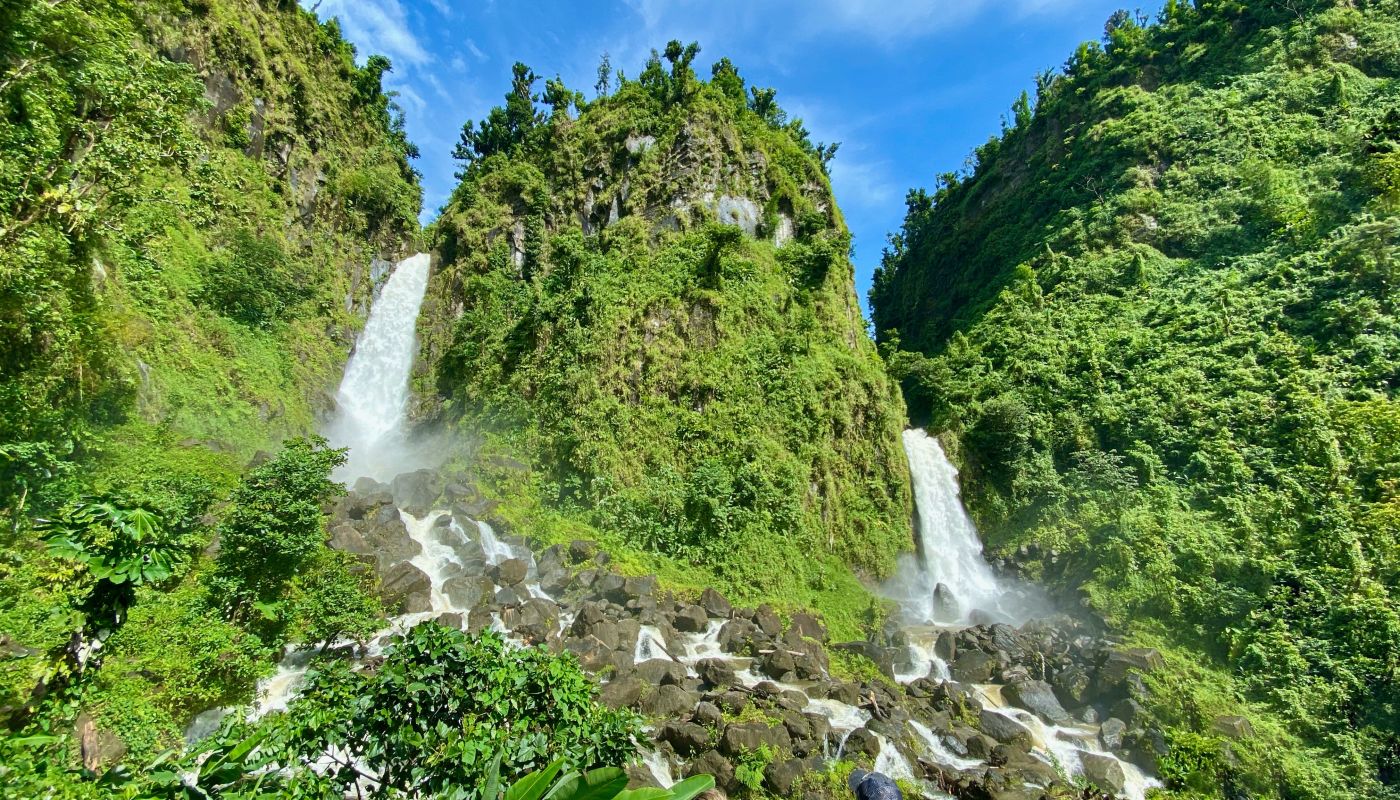
Landscape of Dominica
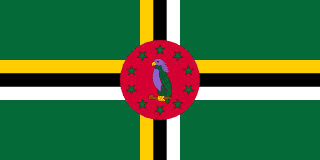
Flag of Dominica

Dominica

Asia

Otherwise known as the Commonwealth of Dominica, Dominica is an independent island nation in the West Indies. The nation has a president acting as the chief of state, as well as a prime minister acting as the head of the government.1 Agriculture, and in particular, bananas, have played a major role in the Dominican economy until recently when the government began to put more emphasis on promoting Dominica as an ecotourism destination. In 2017, Hurricane Maria damaged the nation’s transportation infrastructure and destroyed a majority of the nation’s agricultural resources.2 Dominica is home to the agouti and the manicou, as well as a 179 species of birds, the Lesser Antillean Iguana, sea turtles and a number of kinds of snakes and crabs.3 1 https://www.cia.gov/library/publications/the-world-factbook/geos/do.html 2 Ibid 3 https://www.avirtualdominica.com/project/wildlife/

What would you like to learn about in Dominica?

Select a section to explore the country where nonprofits are creating positive change.

About Dominica

Dominica was the last of the Caribbean islands to be colonized by Europeans due chiefly to the fierce resistance of the native Caribs. France ceded possession to Great Britain in 1763, which made the island a colony in 1805. In 1980, two years after independence, Dominica's fortunes improved when a corrupt and tyrannical administration was replaced by that of Mary Eugenia CHARLES, the first female prime minister in the Caribbean, who remained in office for 15 years. Some 3,000 Carib Indians still living on Dominica are the only pre-Columbian population remaining in the eastern Caribbean.

Quick Facts

Population
73,286 (July 2013 est.)
Area
751 sq km
ISO Code
DM
Continent
Asia
Government
parliamentary democracy
Active Causes
12
View all countries in Asia

Geography & Environment

Climate

tropical; moderated by northeast trade winds; heavy rainfall

Terrain

rugged mountains of volcanic origin

Natural Resources

timber, hydropower, arable land

Environmental Issues

NA

People & Society

76.39 years
Avg. Life Expectancy
94%
Literacy Rate
67% of total population (2010)
Total Urban Population

Languages

English (official), French patois

Religions

Roman Catholic 61.4%, Protestant 20.6% (Seventh-Day Adventist 6%, Pentecostal 5.6%, Baptist 4.1%, Methodist 3.7%, Church of God 1.2%), Jehovah's Witne...

Health Expenditure

7.4% of GDP (2010) of GDP

Education Expenditure

3.5% of GDP (2010) of GDP

Economy

$14,400
GDP per Capita (PPP)
23%
Unemployment Rate
29% (2009 est.)
Below Poverty Line

Economic Overview

The Dominican economy has been dependent on agriculture - primarily bananas - in years past, but increasingly has been driven by tourism as the government seeks to promote Dominica as an "ecotourism" destination. Moreover, Dominica has successfully developed an offshore medical education sector. In order to diversify the island's economy, the government is also attempting to develop an offshore financial sector and plans to sign agreements with the private sector to develop geothermal energy resources. In 2003, the government began a comprehensive restructuring of the economy - including elimi...

Causes in Dominica

Education

In Dominica, primary school lasts eight years, and the two years of secondary education that follow are completed at state schools. Students intending to attend university can complete their schooling through the 12th grade level via a private school, and are all located in urban, wealthy areas on the island.1 91.8 percent of the Dominican population is literate.2

Economy

Agriculture, and in particular, bananas, have played a major role in the Dominican economy until recently when the government began to put more emphasis on promoting Dominica as an ecotourism destination. In 2017, Hurricane Maria damaged the nation’s transportation infrastructure and destroyed a majority of the nation’s agricultural resources.1 Dominica’s national debt grew from 67 percent of the GDP in 2010 to 77 percent in 2016.2 The GDP is $785 million, and the GDP per capita is $11,100.3 Dominica’s primary agricultural products include bananas, citrus, mangos, coconuts and cocoa, while leading industries include soap, coconut oil and shoes.4 23 percent of the population is unemployed, and 29 percent of the population falls below the poverty line.5

Government

Contrary to the governmental model of its neighboring nations, Dominica is a republic with a president as its head of state — not the British monarch. The prime minister is the head of government. Their legal system is modeled after the English legal system.1 Dominica ranks 42nd in the world for governmental transparency and control of corruption with a score of 57 out of 100 — a mid-range score.2

Health

18.9 percent of the Dominican population lacks access to modern sanitation facilities, and 4 percent lack access to an improved water source.1 The life expectancy at birth is 77 years, and the infant mortality rate is 10 deaths for every 1,000 live births.2 Antenatal care is universal, and nearly every birth is overseen by a skilled health professional.3 Leading causes of death include circulatory system diseases and neoplasms, or cancer.4 Health expenditures account for 5.5 percent of the Dominican GDP.5

Children

Nearly 42 percent of Dominicans are between the ages of 0–24.1 The infant mortality rate is 10.6 deaths per 1,000 live births.2 UNICEF identifies several child populations in Dominica as vulnerable: children living in single mother households — particularly when the mother is engaged is harmful male relationships, children in abusive or dysfunctional households, pregnant adolescents, children in some form of alternative residential care facility and migrant populations.3 39 percent of households are led by a woman, and are more likely to be impoverished than households led by men.4 Primary schooling lasts eight years, and the two years of secondary education that follow are completed at state schools. Students intending to attend university can complete their schooling through the 12th grade level via a private school, and are all located in urban, wealthy areas on the island.5

Environment

Dominica is party to a number of environmental policies, including international agreements on biodiversity, endangered species, desertification, climate change, environmental modification, whaling, and ship pollution.1 60 percent of Dominica is covered by forest, and the nation is home to the second-largest thermally active lake in the world, Boiling Lake.2 Agrochemical pollution, as well as pollution from untreated sewage, soil erosion and pollution of the coastal zone are some of the primary environmental concerns in the nation.3

Family

There are no official statistics available on domestic violence in Dominica. The infant mortality rate is 10 deaths for every 1,000 live births.1 Families led by single mothers are more prone to poverty, and 39 percent of households in Dominica are led by women.2

Human Rights

The condition of human rights in Dominica is fairly stable; elections are viewed as free and fair, and there are few to no reports on local security forces abusing their authority. Authorities that did abuse their power were punished.1 The constitution provides for fair and public trials of those charged with a crime.2 Victims of human rights violations can appeal to the Inter-American Commission on Human Rights for their case to be heard.3

Poverty

28 percent of the population is below the poverty line, and the unemployment rate is 23 percent.1 49 percent of the native Kalingo population is under the poverty line; the Kalingo are the sole remaining pre-Columbian population left in the Caribbean region.2 18.9 percent of the population lacks access to modern sanitation facilities.3

Religion

Dominica is predominantly Catholic, with 61.4 percent of the population claiming Catholicism as their faith. 28.6 percent identify as Protestant, 1.3 percent are Rastafarian, 1.2 percent identify as Jehovah’s Witness, 0.3 percent identify as other, 6.1 percent as none, and 1.1 percent are unspecified.1 The Dominican constitution recognizes its citizens’ rights to religious freedom, and the government upholds this principle.2

Clean Water

4 percent of the Dominican population lacks access to water from an improved water source, and 18.9 percent lacks access to modern sanitation facilities.1 Fresh water shortages and untreated sewage are a couple of the nation’s environmental concerns.2

Animals

Dominica is home to the agouti and the manicou, as well as a 179 species of birds, the Lesser Antillean Iguana, sea turtles and a number of kinds of snakes and crabs. Sperm whales are also known to frequent the waters around Dominica, alongside 45 species of fish.1 The nation is party to international environmental agreements on biodiversity and endangered species.2

Nonprofits Working in Dominica

Discover organizations making a difference in Dominica

Make Your Impact Today

Discover causes you care about and support the nonprofits making a difference in communities around the world.

Are you a nonprofit? Join Project World Impact for free

Join Us Free