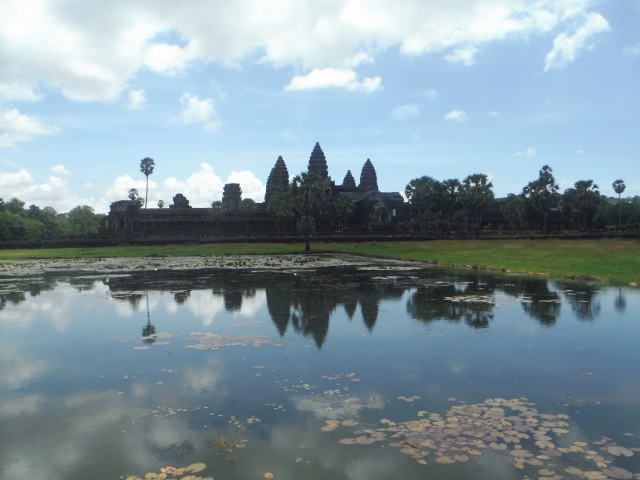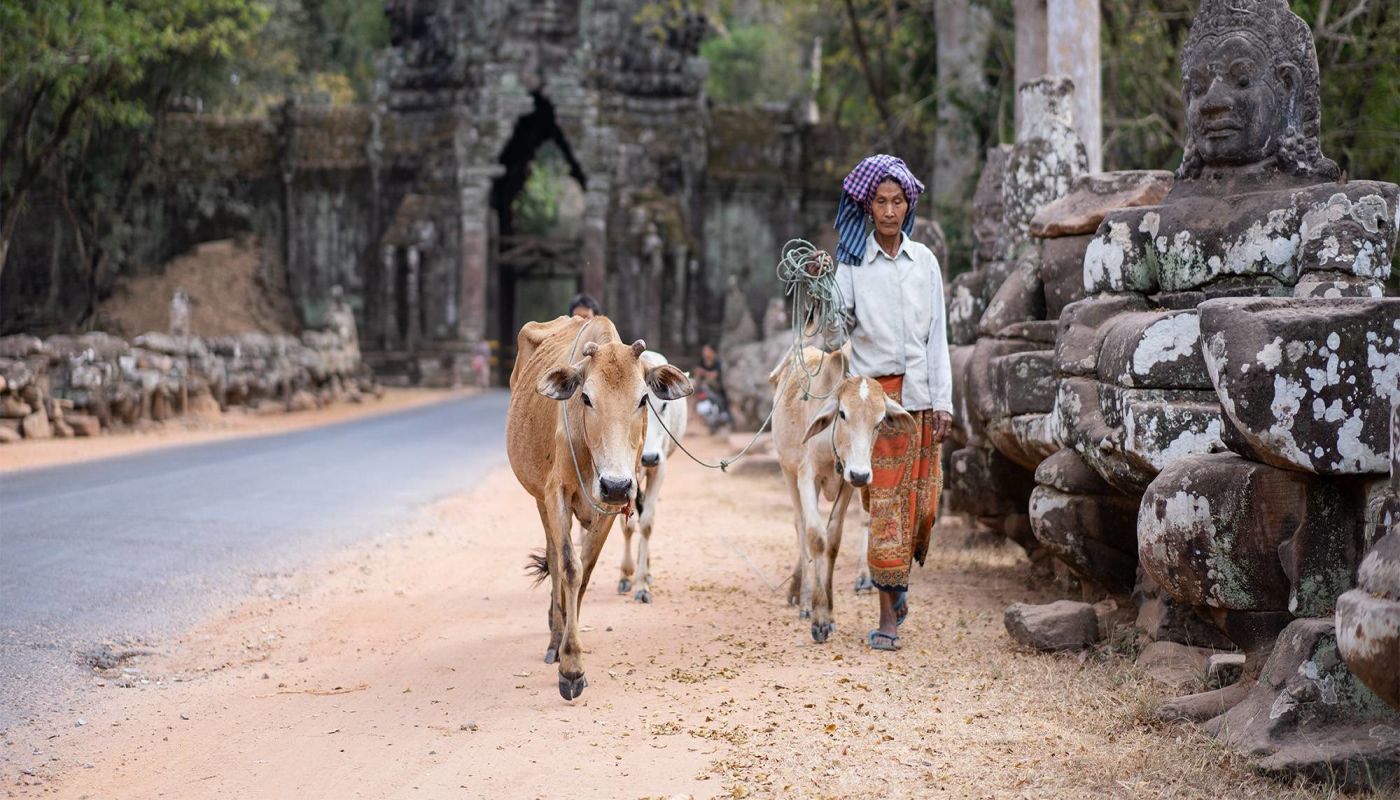
Landscape of Cambodia
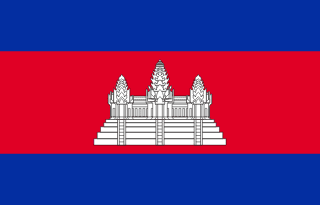
Flag of Cambodia

Cambodia

Asia

Cambodia became independent of France in 1953. In 1975, after a conflict lasting several years, the communist regime, Khmer Rouge, overtook the capital of Phnom Penh and emptied the towns and cities surrounding it. An estimated 1.5 million Cambodians died either from execution or various other hardships under Khmer Rouge. In 1978, Vietnamese forces overtook Phnom Penh, sending Khmer Rouge to remote regions of the nation, and began what became a 10 year occupation — and 13 years of war — between Khmer Rouge and the Vietnamese forces.1 Since then, numerous coalition governments have formed, with the assistance of the United Nations, and fluctuated, falling in and out of power, or dissolving altogether. In fall of 2017, the sitting prime minister arrested the acting president, and ousted the Cambodian National Rescue Party from their seats in the National Assembly, banning the party members from participating in national politics for five years, just prior to the 2018 elections.2 1 https://www.cia.gov/library/publications/the-world-factbook/geos/cb.html 2 Ibid

What would you like to learn about in Cambodia?

Select a section to explore the country where nonprofits are creating positive change.

About Cambodia

Most Cambodians consider themselves to be Khmers, descendants of the Angkor Empire that extended over much of Southeast Asia and reached its zenith between the 10th and 13th centuries. Attacks by the Thai and Cham (from present-day Vietnam) weakened the empire, ushering in a long period of decline. The king placed the country under French protection in 1863, and it became part of French Indochina in 1887. Following Japanese occupation in World War II, Cambodia gained full independence from France in 1953. In April 1975, after a five-year struggle, communist Khmer Rouge forces captured Phnom Penh and evacuated all cities and towns. At least 1.5 million Cambodians died from execution, forced hardships, or starvation during the Khmer Rouge regime under POL POT. A December 1978 Vietnamese invasion drove the Khmer Rouge into the countryside, began a 10-year Vietnamese occupation, and touched off almost 13 years of civil war. The 1991 Paris Peace Accords mandated democratic elections and a ceasefire, which was not fully respected by the Khmer Rouge. UN-sponsored elections in 1993 helped restore some semblance of normalcy under a coalition government. Factional fighting in 1997 ended the first coalition government, but a second round of national elections in 1998 led to the formation of another coalition government and renewed political stability. The remaining elements of the Khmer Rouge surrendered in early 1999. Some of the surviving Khmer Rouge leaders have been tried or are awaiting trial for crimes against humanity by a hybrid UN-Cambodian tribunal supported by international assistance. Elections in July 2003 were relatively peaceful, but it took one year of negotiations between contending political parties before a coalition government was formed. In October 2004, King Norodom SIHANOUK abdicated the throne and his son, Prince Norodom SIHAMONI, was selected to succeed him. Local elections were held in Cambodia in April 2007, with little of the pre-election violence that preceded prior elections. National elections in July 2008 were relatively peaceful, as were commune council elections in June 2012.

Quick Facts

Population
15,205,539 (July 2013 est.)
Area
181,035 sq km
ISO Code
KH
Continent
Asia
Government
multiparty democracy under a constitutional monarchy
Active Causes
12
View all countries in Asia

Geography & Environment

Climate

tropical; rainy, monsoon season (May to November); dry season (December to April); little seasonal temperature variation

Terrain

mostly low, flat plains; mountains in southwest and north

Natural Resources

oil and gas, timber, gemstones, iron ore, manganese, phosphates, hydropower potential

Environmental Issues

illegal logging activities throughout the country and strip mining for gems in the western region along the border with Thailand have resulted in habitat loss and declining biodiversity (in particular...

People & Society

63.41 years
Avg. Life Expectancy
73.9%
Literacy Rate
20% of total population (2011)
Total Urban Population

Languages

Khmer (official) 95%, French, English

Religions

Buddhist (official) 96.4%, Muslim 2.1%, other 1.3%, unspecified 0.2% (1998 census)

Health Expenditure

5.6% of GDP (2010) of GDP

Education Expenditure

2.6% of GDP (2010) of GDP

Economy

$2,400
GDP per Capita (PPP)
0%
Unemployment Rate
20% (2012 est.)
Below Poverty Line

Economic Overview

Since 2004, garments, construction, agriculture, and tourism have driven Cambodia's growth. GDP climbed more than 6% per year between 2010 and 2012. The garment industry currently employs more about 400,000 people and accounts for about 70% of Cambodia's total exports. In 2005, exploitable oil deposits were found beneath Cambodia's territorial waters, representing a potential revenue stream for the government, if commercial extraction becomes feasible. Mining also is attracting some investor interest and the government has touted opportunities for mining bauxite, gold, iron and gems. The touri...

Causes in Cambodia

Environment

Cambodia’s primary environmental issues include strip mining along the border of Thailand, as well as deforestation and improper logging procedures. This creates a loss of animal habitat as well as biodiversity.1 Cambodia’s geography is filled with rice paddies, as well as forests. Its main bodies of water are the Mekong River and the Tonle Sap, Cambodia’s largest freshwater lake.2 Other environmental problems include illegal fishing and soil erosion, as well as sediment-congested coastal ecosystems from the deforestation occurring inland.3 Cambodia is home to the largest population of Irrawaddy dolphins, and is also the home to the Indochinese tiger and Asian elephant.4

Family

Before 1989, polygamy in Cambodia was legal and could be sanctioned during a ceremony.1 Though it is no longer legal, having a second wife does not carry the same degree of stigma that it does in Western cultures.2 For young adults in Cambodia, there is strong societal and familial pressure to marry and have children.3 Although divorce is a legal option, there is considerable cultural pressure against divorce.4 Domestic violence is also a prevalent issue, according to the UNDP, though statistics are not collected on the number of Cambodian women who are victims of abuse.5 The nation additionally has high maternal and infant mortality rates with 161 maternal deaths per 100,000 live births and 47 deaths per 1,000 lives births for infants.6

Human Rights

In Cambodia, all state and private television stations, websites, radio stations and print media are controlled by the Cambodian People’s Party, and independent civil and media groups are subject to closure or detention.1 In 2017, the current government — led by the Cambodia People’s Party (CPP) — arrested the leader of their primary political opposition, Kem Sokha of the Cambodia National Rescue Party (CNRP).2 This followed the arrest of the former CNRP leader earlier that year. Several other leaders from the CNRP in parliament were also detained. Experts say that the CPP is attempting to dissolve any opposition in elections.3 The United Nations Human Rights Council has assigned another two-year UN special rapporteur to Cambodia that will provide reports on the state of human rights in the nation to the UNHRC.4

Education

Primary education enrollment increased by 15 percent in the last 20 years, but secondary education completion rates are still low — just 48 percent in 2015.1 Cambodia’s literacy rate is 77 percent, and education expenditures account for just 1.9 percent of the GDP.2 Children from rural communities and ethnic minorities are at a disadvantage and likely to face exclusion even as the Cambodian education program improves.3 Lack of proper nutrition also compounds education issues, as well as financial concerns within the family that may result in parents asking children to help financially support the family rather than attend school.4

Poverty

17 percent of the population is below the poverty line;1 the rate has declined each year since 2007 when the poverty rate was at 31 percent.2 However, the GDP per capita is still just $4000.3 Cambodia is currently one of the least urbanized countries in Southeast Asia.4 A quarter of the population lacks access to clean water, and 57 percent of Cambodians lack access to proper sanitation facilities.5 Cambodia also has one of the largest populations of people living with HIV/AIDS in the world, an estimated 71,000 in 2016.6

Religion

Buddhism is the official religion of Cambodia, with 96.9 percent of the population identifying as Buddhist. The remainder of the population is Muslim (1.9 percent), Christian (0.4 percent) or other (0.8 percent).1 Though Buddhism is the official state religion, the freedom of religion is primarily upheld in the nation.2

Clean Water

Cambodia is currently one of the least urbanized countries in Southeast Asia.1 A quarter of the population lacks access to clean water, and 57 percent of Cambodians lack access to proper sanitation facilities.2 Water resources are owned and operated by the state, and can become challenging to maintain in and out of the rainy seasons; water cleanliness being the primary issue — not quantity.3 In 2007, a law was implemented to boost investment in the water sector and benefit the agricultural industry through irrigation, the Law of Water Resource Management.4

Economy

In the past decade, Cambodia’s economy has grown readily.1 Tourism, textile exports and agriculture contributed to the steady increase in economic health; in 2016, the World Bank reclassified Cambodia as a lower, middle-income nation as a result of their growth, but still remains one of the poorest countries in Asia.2 The GDP per capita is $4000, and 17.7 percent of the population falls below the poverty line.3 However, Cambodia’s average growth rate is 7.6 percent, ranking sixth in the world for economic growth by GDP.4

Government

Cambodia became independent of France in 1953. In 1975, after a conflict lasting several years, the communist regime, Khmer Rouge, overtook the capital of Phnom Penh and emptied the towns and cities surrounding it. An estimated 1.5 million Cambodians died either from execution or various other hardships under Pol Pot’s Khmer Rouge. In 1978, Vietnamese forces overtook Phnom Penh, sending Khmer Rouge to remote regions of the nation, and began what became a 10 year occupation as well as 13 years of war between Khmer Rouge and the Vietnamese forces.1 Since then, numerous coalition governments have formed — with the assistance of the United Nations — and fluctuated, falling in and out of power, or dissolving altogether. In fall of 2017, the sitting prime minister arrested the acting president, and ousted the Cambodian National Rescue Party from their seats in the National Assembly, banning the party members from participating in national politics for five years, just prior to the 2018 elections.2 The government is classified as a parliamentary constitutional monarchy.3 Transparency International ranks Cambodia as 161st on their Corruption Perceptions Index, with a low score of 21.4

Health

Cambodia has one of the largest populations of people living with HIV/AIDS, an estimated 71,000 in 2016.1 There is high risk of major infectious diseases in the nation, including hepatitis A, typhoid fever, japanese encephalitis, dengue and malaria,2 as many rural communities still lack access to clean water and proper sanitation facilities.3 A quarter of the population lacks access to clean water, and 57 percent of Cambodians lack access to proper sanitation facilities.4 Nearly 25 percent of children under the age of 5 are underweight.5 The leading causes of death are stroke, lower respiratory infection and heart disease.6

Children

Child prostitution is rampant in Cambodia, as the country is ridden with poverty and destitution. Officials say that it was after the crumbling of the Khmer Rouge regime that the industry grew. Men can even be known to ask for girls under 10 when visiting massage parlors and karaoke bars, brothels in disguise.1 Orphanage tourism is also an issue in Cambodia, as tourists visit the country to offer assistance to illegitimate orphanages to function to gain profit from the donations of visitors. Often the children are not truly orphans, but are placed in the orphan care system unnecessarily.2

Animals

Cambodia is home to the largest population of Irrawaddy dolphins, and is also home to the Indochinese tiger and Asian elephant.1 Illegal fishing and habitat destruction through deforestation both present issues for the nation’s wildlife.2 The Lower Mekong Dry Forests are home to several unique wild cattle and deer species, some of which are endangered. Wild water buffalo also reside in the Eastern Plain’s Mondulkiri Forest.3

Nonprofits Working in Cambodia

Discover organizations making a difference in Cambodia

Rising International

Rising International

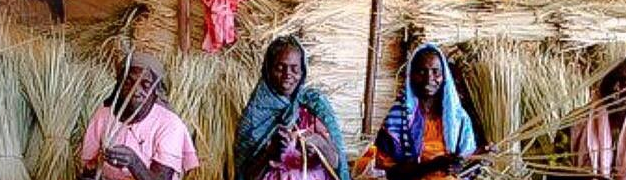
Our Unique Local-Global Solution Rising International is a nonprofit organization that has revolutionized the home party business model to alleviate poverty locally and globally. Think Avon or Tupperware for a social cause. We find the world’s most forgotten women (like Fatima) and enable them to change their destinies by selling their handmade crafts at Rising Home and Corporate Parties. We train women and teens, many un-employed or under- employed, (like Susana) to run their own Rising Home Party businesses and sell crafts made by their global sisters. We search the U.S. for party hosts (like Nancy) who invite friends to their homes to shop. Our sustainable model empowers both local and global entrepreneurs to rise above their circumstances.

Santa Cruz, California

Make Your Impact Today

Discover causes you care about and support the nonprofits making a difference in communities around the world.

Are you a nonprofit? Join Project World Impact for free

Join Us Free