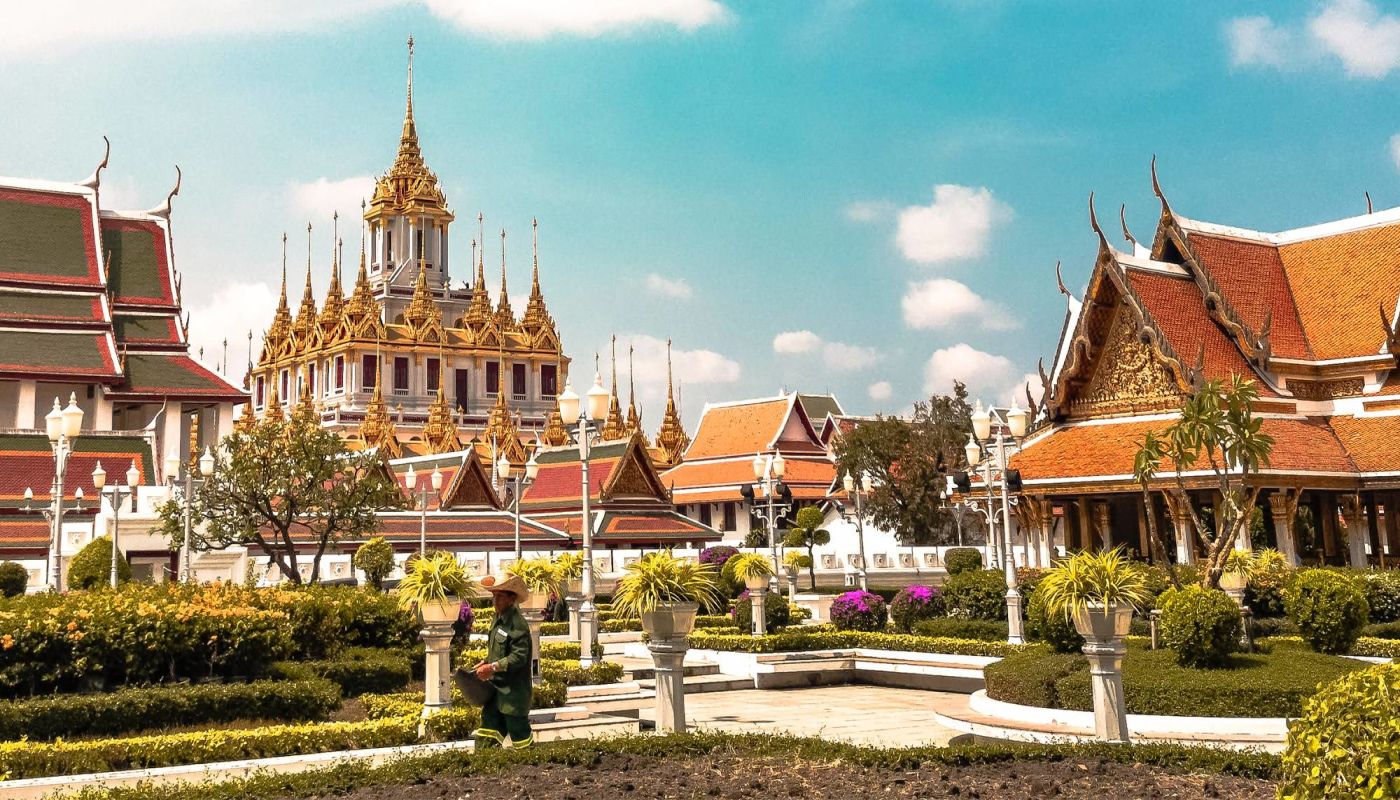
Landscape of Thailand
Flag of Thailand

Thailand

Asia

A military coup in 2014 affected many aspects of Thai culture. The ruling military placed censorship on media members, illegally detained citizens and subjected them to military trials, and ignored human rights trials. They ignored international requests to restore democracy to the country and were denied a seat in the United Nations security council for 2017-2018.1 In recent years, Thailand has led the world in its measures against air pollution by decreasing emissions and creating better living conditions for citizens in the capital city of Bangkok.2 1 https://www.hrw.org/world-report/2017/country-chapters/thailand 2 http://www.worldbank.org/en/news/feature/2015/04/13/from-santiago-to-bangkok-cleaner-air-brings-healthier-lives

What would you like to learn about in Thailand?

Select a section to explore the country where nonprofits are creating positive change.

About Thailand

A unified Thai kingdom was established in the mid-14th century. Known as Siam until 1939, Thailand is the only Southeast Asian country never to have been taken over by a European power. A bloodless revolution in 1932 led to a constitutional monarchy. In alliance with Japan during World War II, Thailand became a US treaty ally in 1954 after sending troops to Korea and later fighting alongside the United States in Vietnam. Thailand since 2005 has experienced several rounds of political turmoil including a military coup in 2006 that ousted then Prime Minister THAKSIN Chinnawat, followed by large-scale street protests by competing political factions in 2008, 2009, and 2010. Demonstrations in 2010 culminated with clashes between security forces and pro-THAKSIN protesters, elements of which were armed, and resulted in at least 92 deaths and an estimated $1.5 billion in arson-related property losses. THAKSIN's youngest sister, YINGLAK Chinnawat, in 2011 led the Puea Thai Party to an electoral win and assumed control of the government. YINGLAK's leadership was almost immediately challenged by historic flooding in late 2011 that had large swathes of the country underwater and threatened to inundate Bangkok itself. Throughout 2012 the Puea Thai-led government struggled with the opposition Democrat Party to fulfill some of its main election promises, including constitutional reform and political reconciliation. Since January 2004, thousands have been killed and wounded in violence associated with the ethno-nationalist insurgency in Thailand's southern Malay-Muslim majority provinces.

Quick Facts

Population
67,448,120 (July 2013 est.)
Area
513,120 sq km
ISO Code
TH
Continent
Asia
Government
constitutional monarchy
Active Causes
12
View all countries in Asia

Geography & Environment

Climate

tropical; rainy, warm, cloudy southwest monsoon (mid-May to September); dry, cool northeast monsoon (November to mid-March); southern isthmus always hot and humid

Terrain

central plain; Khorat Plateau in the east; mountains elsewhere

Natural Resources

tin, rubber, natural gas, tungsten, tantalum, timber, lead, fish, gypsum, lignite, fluorite, arable land

Environmental Issues

air pollution from vehicle emissions; water pollution from organic and factory wastes; deforestation; soil erosion; wildlife populations threatened by illegal hunting

People & Society

74.05 years
Avg. Life Expectancy
93.5%
Literacy Rate
34.1% of total population (2011)
Total Urban Population

Languages

Thai, English (secondary language of the elite), ethnic and regional dialects

Religions

Buddhist (official) 94.6%, Muslim 4.6%, Christian 0.7%, other 0.1% (2000 census)

Health Expenditure

3.9% of GDP (2010) of GDP

Education Expenditure

3.8% of GDP (2010) of GDP

Economy

$10,300
GDP per Capita (PPP)
0.7%
Unemployment Rate
7.8% (2010 est.)
Below Poverty Line

Economic Overview

With a well-developed infrastructure, a free-enterprise economy, generally pro-investment policies, and strong export industries, Thailand achieved steady growth due largely to industrial and agriculture exports - mostly electronics, agricultural commodities, automobiles and parts, and processed foods. Thailand is trying to maintain growth by encouraging domestic consumption and public investment to offset weak exports in 2012. Unemployment, at less than 1% of the labor force, stands as one of the lowest levels in the world, which puts upward pressure on wages in some industries. Thailand also...

Causes in Thailand

Environment

The main environmental issues that Thailand faces are deforestation, soil erosion, wildlife trade, and air and water pollution. The positive economic development that Thailand has experienced has come at the price of the degradation of the country’s extensive natural resources. 1 In 2015, the government adopted emission standards, phased out lead in gasoline, and removed a number of polluting rickshaws in the streets to decrease air pollution in Bangkok. Better air quality has already improved the health and quality of life of residents in the city.2 Worldwide climate change affects farmland in Thailand, making lowlands and coastal areas more susceptible to flooding. In order to curb the effects of climate change, the government developed a Climate Change Action Plan in order to educate the public and implement regulations about environmental conservation.3

Family

Family planning has contributed greatly to Thailand’s success as a country ever since they became serious about the implementation of family planning programs in the 1970s.1 As a result, Thailand has a smaller population compared to other Asian countries, a growing economy, and fewer people living in poverty.2 Despite these advancements, an alarming trend in Thailand is the steady rise of domestic violence. Due to societal and cultural restraints, many women who are abused in their homes remain silent and do not seek outside help which only perpetuates the cycle of violence.3

Human Rights

In May 2014, martial law was declared across Thailand and paved the way for a variety of human rights violations. The military council placed censorship on the media and doesn’t allow citizens to publicly protest the monarchy. The government gives blanket amnesty for corruption, which has augmented political divisions among the citizens. State security forces have been cited for carrying out extrajudicial killings and enforced disappearances.1 Additionally, authorities largely ignored any human rights abuses committed against migrant workers.2

Education

90% of school-aged children in Thailand are enrolled in primary school. However, only 75% of the students who begin primary school complete secondary education.1 Refugee and migrant children struggle to receive proper education, but some aid organizations provide informal education and curriculum in refugee centers.2 Thailand is the educational administrative seat of the Association of Southeast Asian Nations (ASEAN), so its reforms and precedent set the tone for the region.3

Poverty

Approximately 13% of the country lives below the poverty line.1 Despite improvement efforts, there is still inequality in regards to poverty in Thailand, as 80% of impoverished citizens live in rural areas.2 In past decades, the government has undertaken several rural development programs specifically aimed at the poorest economic sectors of the country. These have largely been successful and have introduced programs for poverty reduction, nutrition improvement, and low-cost housing.3

Religion

Religious freedom is maintained in the Thai constitution for all citizens, and there is no official state religion. Around 95% of the population practices Theravada Buddhism, and the law necessitates that the king subscribe to Theravada Buddhism.1 A large community of Buddhist monks is located in Thailand, and almost every settlement in the country has a temple where monks reside.2 A small percentage of people practicing Islam live near the Malaysian border, in the southernmost provinces of Thailand. There is an ongoing, low-intensity war in this region because of tensions between Thai Buddhist citizens and the ethnic Muslim Malay communities. At the end of 2016, 6,000 people had died in sporadic attacks from both sides.3

Clean Water

As with many other countries throughout Asia, rising population, urbanization, and agricultural and industrial expansion have had a negative effect on Thailand’s water sources. The overall quality of groundwater has been degraded as a result of pollutants from human activities. Furthermore, Thailand experiences intense flooding in the rainy season and extreme droughts in the dry season, which can bring challenges to supplying a steady flow of water for its citizens. Approximately one-third of all surface water is of poor quality in Thailand and domestic sewage, industrial wastewater, and other hazardous wastes have vastly increased in recent years.1 Despite these challenges, 98% of the population has access to clean water and 93% have access to improved sanitation.2

Economy

The Thai economy has a developed infrastructure, high foreign investment, and a strong export industry. Thailand also has an extremely low unemployment rate at 1%.1 There have been several decades of steady growth, allowing it to sustain strong, long-term growth while simultaneously reducing poverty. However, the benefits of this economic growth have not been equally distributed amongst the population. 7% of the country still lives in poverty, and 80% of those live in rural areas. The inequality is exacerbated by droughts and falling agricultural prices.2

Government

Thailand has a constitutional monarchy government with a king as the chief of state and prime minister as the head of government.1 In 2016, the king passed away after a 70 year reign and a militaristic rule ensued. The majority of power lies in the hands of a military council which has placed restrictions on many freedoms. The council also took over the judicial system and retains power to arrest and try civilians at any time. As of 2017, the government has denied international requests to restore democratic order to Thailand.2

Health

71% of deaths in Thailand are caused by non-communicable diseases, like heart and respiratory conditions. Road accidents follow closely behind in causes of death.1 Strokes are also becoming a huge health care challenge for Thailand and they are the leading cause of long-term disabilities in both genders.2 Since 2002, Thailand has had nearly universal health care coverage for its citizens.1 Treatment is completely free for Thai citizens, but government hospitals and medical centers are often overcrowded. Citizens can receive better quality at private clinics, but often poorer citizens cannot afford to pay for it.3 Thailand is also the only country in the world that provides equal universal health care for illegal migrants. The health coverage provides treatment for chronic illnesses such as HIV that are common among the migrant population.4

Children

Child prostitution and human trafficking are major challenges facing children in Thailand.1 53% of human trafficking victims are under the age of 16. Since Thailand serves as a source, transit, and destination country for the industry, government measures to end the abhorrent practice are difficult to coordinate. The child prostitution industry in Thailand has flourished due to the lack of societal condemnation of the practice and the fiscal gains the government receives by the increase of foreign tourism.1 An estimated 130,000 refugees live in Thailand, and because less than 10% of these migrant children attend schools, they are left increasingly vulnerable to the sex industry and human traffickers.2,3

Animals

Water buffaloes, horses, oxen, and elephants are traditionally used in agriculture. Rapid deforestation and illegal sale of exotic animals has endangered many species like rhinoceroses and tapirs. Overfishing has also decreased the amounts of many indigenous species along the coastlines. Reform measures to conserve animal species have been largely unsuccessful.1

Nonprofits Working in Thailand

Discover organizations making a difference in Thailand

Make Your Impact Today

Discover causes you care about and support the nonprofits making a difference in communities around the world.

Are you a nonprofit? Join Project World Impact for free

Join Us Free