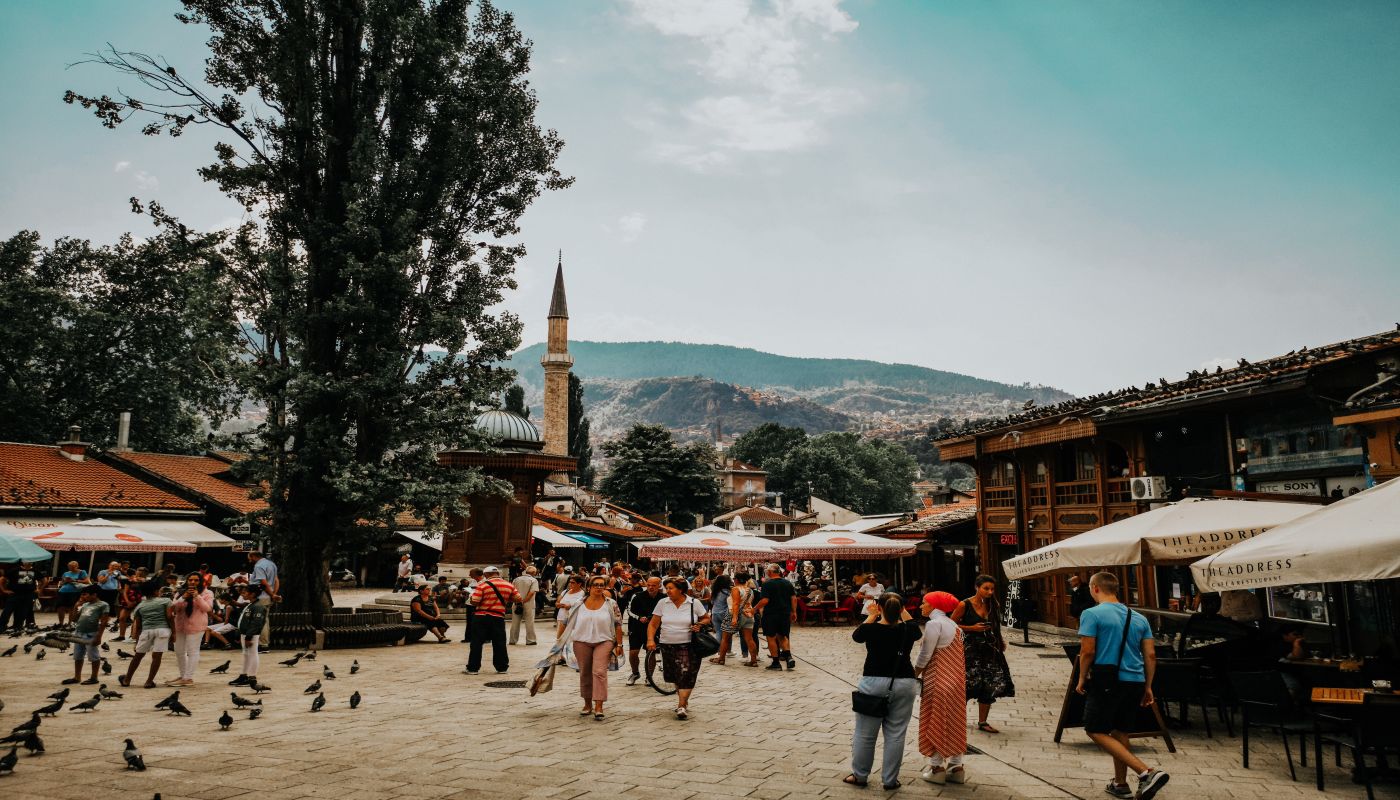
Landscape of Bosnia and Herzegovina
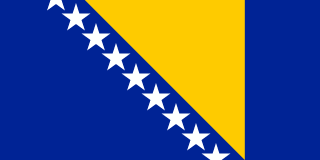
Flag of Bosnia and Herzegovina

Bosnia and Herzegovina

Europe

After Bosnia and Herzegovina declared their independence from the former communist Yugoslavia, an armed resistance brought three years of violent civil uprisings,1 in which an estimated 100,000 people were killed. 80 percent were Muslim Bosniaks, resulting in the largest ethnic cleansing since the Holocaust.2 Peace was not declared until 1995 when the Dayton Peace Accords established the international boundaries of Bosnia and Herzegovina, creating a multi-ethnic state divided into The Federation of Bosnia and Herzegovina and the Republic of Srpska.3 The government is decentralized; each division has its own constitution.4 All three regions are primarily divided along ethnic lines, Bosniak, Serb and Croat. Each ethnic group has its own member of the presidency, elected every four years by majority vote.5 In 2016, 1,300 young people entered into community dialogue led by the UNDP to address division and discuss peacemaking and diversity in BiH.6 Though Bosnia and Herzegovina applied for membership to the European Union, they do not yet meet the requirements for admittance, which include a “free-market economy, a stable democracy and the rule of law, and the acceptance of all EU legislation, including of the euro.”7 Much of the private sector chooses to conduct business in the vast informal economic system in BiH, as recollections of the war, and distrust of the government, persist, thus slowing formal economic growth.8 1 https://www.cia.gov/library/publications/the-world-factbook/geos/bk.html 2 https://www.ushmm.org/confront-genocide/cases/bosnia-herzegovina 3 https://www.cia.gov/library/publications/the-world-factbook/geos/bk.html 4 Ibid 5 https://www.worldatlas.com/articles/what-type-of-government-does-bosnia-and-herzegovina-have.html

What would you like to learn about in Bosnia and Herzegovina?

Select a section to explore the country where nonprofits are creating positive change.

About Bosnia and Herzegovina

Bosnia and Herzegovina's declaration of sovereignty in October 1991 was followed by a declaration of independence from the former Yugoslavia on 3 March 1992 after a referendum boycotted by ethnic Serbs. The Bosnian Serbs - supported by neighboring Serbia and Montenegro - responded with armed resistance aimed at partitioning the republic along ethnic lines and joining Serb-held areas to form a "Greater Serbia." In March 1994, Bosniaks and Croats reduced the number of warring factions from three to two by signing an agreement creating a joint Bosniak/Croat Federation of Bosnia and Herzegovina. On 21 November 1995, in Dayton, Ohio, the warring parties initialed a peace agreement that brought to a halt three years of interethnic civil strife (the final agreement was signed in Paris on 14 December 1995). The Dayton Peace Accords retained Bosnia and Herzegovina's international boundaries and created a multi-ethnic and democratic government charged with conducting foreign, diplomatic, and fiscal policy. Also recognized was a second tier of government composed of two entities roughly equal in size: the Bosniak/Bosnian Croat Federation of Bosnia and Herzegovina and the Bosnian Serb-led Republika Srpska (RS). The Federation and RS governments are responsible for overseeing most government functions. Additionally, the Dayton Accords established the Office of the High Representative (OHR) to oversee the implementation of the civilian aspects of the agreement. The Peace Implementation Council (PIC) at its conference in Bonn in 1997 also gave the High Representative the authority to impose legislation and remove officials, the so-called "Bonn Powers." An original NATO-led international peacekeeping force (IFOR) of 60,000 troops assembled in 1995 was succeeded over time by a smaller, NATO-led Stabilization Force (SFOR). In 2004, European Union peacekeeping troops (EUFOR) replaced SFOR. Currently EUFOR deploys around 600 troops in theater in a policing capacity.
Quick Facts

Population
3,875,723 (July 2013 est.)
Area
51,197 sq km
ISO Code
BA
Continent
Europe
Government
emerging federal democratic republic
Active Causes
12
View all countries in Europe

Geography & Environment

Climate

hot summers and cold winters; areas of high elevation have short, cool summers and long, severe winters; mild, rainy winters along coast

Terrain

mountains and valleys

Natural Resources

coal, iron ore, bauxite, copper, lead, zinc, chromite, cobalt, manganese, nickel, clay, gypsum, salt, sand, timber, hydropower

Environmental Issues

air pollution from metallurgical plants; sites for disposing of urban waste are limited; water shortages and destruction of infrastructure because of the 1992-95 civil strife; deforestation

People & Society

76.12 years
Avg. Life Expectancy
98%
Literacy Rate
49% of total population (2010)
Total Urban Population

Languages

Bosnian (official), Croatian (official), Serbian

Religions

Muslim 40%, Orthodox 31%, Roman Catholic 15%, other 14%

Health Expenditure

11.1% of GDP (2010) of GDP

Education Expenditure

NA of GDP

Economy

$8,400
GDP per Capita (PPP)
43.3%
Unemployment Rate
18.6% (2007 est.)
Below Poverty Line

Economic Overview

Bosnia has a transitional economy with limited market reforms. The economy relies heavily on the export of metals as well as on remittances and foreign aid. A highly decentralized government hampers economic policy coordination and reform, while excessive bureaucracy and a segmented market discourage foreign investment. The interethnic warfare in Bosnia and Herzegovina caused production to plummet by 80% from 1992 to 1995 and unemployment to soar. With an uneasy peace in place, output recovered in 1996-99 but slowed in 2000-02 and picked up again during 2003-08, when GDP growth exceeded 5% per...

Causes in Bosnia and Herzegovina

Environment

By 2025, BiH projects that it will be a “green economy,” a direct result of implementing the Climate Change Adaptation and Low-Emissions Development Strategy.1 The country has begun to regulate the efficiency of their industries and energy production.2 Air pollution, deforestation and inadequate flood and sewage management systems are BiH’s leading environmental issues.3 Each year, 44,000 years of life are lost from nitrogen dioxide pollution in the air, a side effect of electricity plants fueled by coal.4 The waste from such plants — ash and slag — are transported to landfills, and heavy metals from the facilities can seep into nearby bodies of water.5 Over the course of three months in 2014, severe floods overwhelmed BiH and Serbia, affecting 2 million people, resulting in damage costing billions of euro.6

Family

In the Balkans region, Bosnia and Herzegovina has one of the lowest divorce rates.1 Additionally, Bosnia has one of the lowest birth rates in the world, with just 8.8 births per 1,000 members of the population.2 In BiH, Roma children are three times less likely to reach their first birthday, and one in every three Roma children do not attend school.3 Nearly 50 percent of Roma women believe it is acceptable for a husband to beat or hit his spouse or partner, according to UNICEF.4 Bosnia has, however, ratified the Convention on Preventing and Combating Violence against Women and Domestic Violence, created by the Council of Europe to prevent violence and abuse against women and girls.5

Human Rights

After Bosnia and Herzegovina declared their independence from the former communist Yugoslavia, an armed resistance brought in three years of violent civil uprisings,1 in which an estimated 100,000 people were killed. 80 percent were Muslim Bosniaks. Peace was not declared until 1995, three years after the conflicts began.2 It was the largest ethnic cleansing in Europe since the Holocaust.3 In summer of 2018, the United Nations High Commissioner for Human Rights encouraged Bosnia to dissolve ethnic discrimination on a systemic level, particularly within the nation’s school system and electoral law.4 In 2016, 1,300 young people entered into community dialogue led by the UNDP to address division and discuss peacemaking and diversity in BiH.5 Bosnia has also ratified the Convention on Preventing and Combating Violence against Women and Domestic Violence, created by the Council of Europe to prevent violence and abuse against women and girls.6 The media faces censoring and pressure from the government, and the national association for journalists reported 52 violations or interferences against the media’s freedom of expression — both verbal and physical — in July of 2018.7

Education

Bosnia and Herzegovina’s primary issue in the education system is social exclusion in education, particularly along ethnic and religious lines:1 Muslim Bosniaks, Orthodox Christian Serbs and Catholic Croats.2 Some primary schools have integrated minority ethnicities — where they were once segregated — yet many continue to segregate their schools.3 The government has made progress toward eliminating discriminatory and offensive material regarding ethnic minorities from learning materials, but social division remains.3 The length of time that the average child attends school is 14 years.4 Primary and secondary school, age 6 until age 19, is free. After completing general secondary schooling, or technical schooling, students can qualify for their diploma to attend university.5 One in every three Roma children do not attend school.6

Poverty

16.9 percent of the population falls below the poverty line, and the GDP per capita is just $11,400, a low rate for the region.1 Additionally, the unemployment rate is 20.5 percent, and the youth unemployment rate is the highest in the world at 62.3 percent.2 The Roma population is particularly vulnerable to poverty; Roma children are three times less likely to reach their first birthday than non-Roma children in Bosnia and Herzegovina.3 UNICEF recognizes the Roma population as the most at-risk and compromised in the nation.4 Of the entire BiH population, 5.2 percent lack access to proper sanitation facilities.5

Religion

The 1992–1995 Bosnian War was the result of ethnic and religious tensions between Catholic Croats, Orthodox Serbs and Muslim Bosniaks.1 Approximately 50.7 percent of the population is Muslim, 30.7 percent is Orthodox, 15.2 percent are Roman Catholic and the remainder are other or undeclared.2 Despite the end to ethno-religious violence within the country, Bosnia and Herzegovina still struggle with the peaceful integration of religion and ethnic groups.3 The Center for Peacebuilding is active within the country to help facilitate reconciliation among the religious groups.4

Clean Water

Clean water is accessible to nearly every citizen of BiH, 99.9 percent of the population. However, 5.2 percent of the population lacks access to improved sanitation facilities.1 The Bileca Waste Water plant near Bileca Lake in Bosnia and Herzegovina treats local waste water, simultaneously protecting Bileca Lake as a fresh, potable water source for the community. Bileca Lake is the largest artificial lake in the Balkans.2

Economy

Bosnia and Herzegovina’s economy is currently in transition, and the market system is fragmented, limiting opportunities for foreign investment.1 Compared to surrounding nations, the BiH economy is the least competitive; the GDP purchasing power is $43.85 billion, and the GDP per capita is $11,400.2 Natural resources form the backbone of the economy. Leading exports in BiH include metals, energy, textiles and furniture.3 Though Bosnia and Herzegovina applied for membership to the European Union, they do not yet meet the requirements for admittance, which include a “free-market economy, a stable democracy and the rule of law, and the acceptance of all EU legislation, including of the euro.”4 Much of the private sector chooses to conduct business in the vast informal economic system in BiH, as recollections of the war, and distrust of the government, persist, thus slowing formal economic growth.5

Government

After Bosnia and Herzegovina declared their independence from the former communist Yugoslavia, an armed resistance brought in three years of violent civil uprisings,1 in which an estimated 100,000 people were killed. 80 percent were Muslim Bosniaks.2 Peace was not declared until 1995 when the Dayton Peace Accords established the international boundaries of Bosnia and Herzegovina, creating a multi-ethnic state divided into The Federation of Bosnia and Herzegovina and the Republic of Srpska.3 The government is decentralized; each division has its own constitution.4 All three regions are primarily divided along ethnic lines, Muslim Bosniak, Orthodox Christian Serb and Catholic Croat. Each ethnic group has its own member of the presidency, elected every four years by majority vote.5 Though Bosnia and Herzegovina form an independent state, they are overseen by an international administration, led by a high representative.6

Health

Bosnia and Herzegovina has one of the lowest birth rates in the world.1 However, the nation has an internationally mid-range life expectancy of nearly 77 years. Health expenditures account for 9.6 percent of the GDP, and 5.2 percent of the population still lacks access to proper sanitation facilities.2 Heart disease, lung cancer and stroke continue to be the leading causes of death.3 Each year, 44,000 years of life are lost from nitrogen dioxide pollution in the air, a side effect of electricity plants fueled by coal.4

Children

Children account for almost one-fifth of the BiH population,1 and the birth rate is 8.8 for every 1,000 members of the population.2 The nation is still recovering from the war in the 1990s, when 2 million citizens were displaced, and the nation’s infrastructure was crippled — roads, electricity and water systems had to be rebuilt — leaving many children vulnerable.3 The oversight of children’s rights is fractured, and is jointly administered by several department of government.4 The nation has the worst youth unemployment rate in the world. 62 percent of 15–24 year olds are unemployed.5 In 2016, 1,300 young people entered into community dialogue led by the UNDP to address division and discuss peacemaking and diversity in BiH.6 Additionally, the government enacted new child labor policies to diminish the use of children in the workforce, and slow the rate of human trafficking. However, the minimum age for a child to enter the workforce does not apply to self-employed children, or children who are part of informal employment opportunities.7

Animals

Before being admitted into the European Union, Bosnia and Herzegovina must implement animal welfare policies that are in accordance with EU standards.1 Wolves, bears, wildcats, wild pigs, chamois, otters, foxes, badgers and falcons all live in Bosnia and Herzegovina, particularly in the nation’s mountain and forest regions.2

Nonprofits Working in Bosnia and Herzegovina

Discover organizations making a difference in Bosnia and Herzegovina

Rising International

Rising International

Our Unique Local-Global Solution Rising International is a nonprofit organization that has revolutionized the home party business model to alleviate poverty locally and globally. Think Avon or Tupperware for a social cause. We find the world’s most forgotten women (like Fatima) and enable them to change their destinies by selling their handmade crafts at Rising Home and Corporate Parties. We train women and teens, many un-employed or under- employed, (like Susana) to run their own Rising Home Party businesses and sell crafts made by their global sisters. We search the U.S. for party hosts (like Nancy) who invite friends to their homes to shop. Our sustainable model empowers both local and global entrepreneurs to rise above their circumstances.

Santa Cruz, California

Make Your Impact Today

Discover causes you care about and support the nonprofits making a difference in communities around the world.

Are you a nonprofit? Join Project World Impact for free

Join Us Free